
Best overall for cross-tradition reflection: Celestrio's Self-Understanding Map. Best for understanding your work patterns: a Western natal-chart reading. Best for discussing a specific career dilemma: a one-on-one astrology consultation. Best for exploring symbolic timing: a transit-focused reading. The best career astrology reading in 2026 helps you frame better questions; it does not tell you which job to accept.
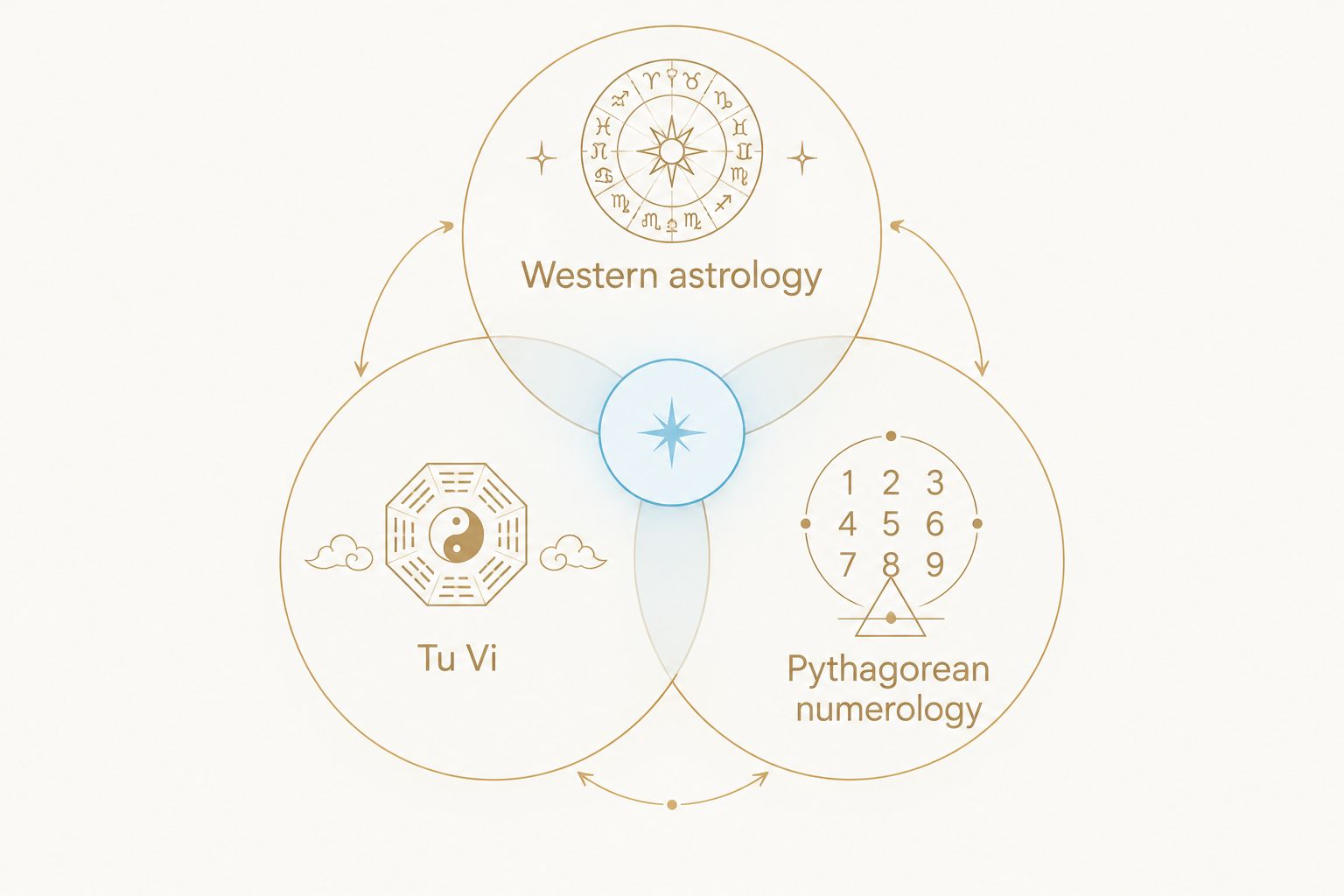
- Celesstrio's Self-Understanding Map combines Tu Vi, Pythagorean numerology, and Western astrology with human review.
- The best career astrology reading supports self-understanding, not guaranteed job predictions or hiring outcomes.
- Choose a natal-chart reading for work patterns, a consultation for questions, and transits for symbolic timing.
- Check birth-time requirements and keep career decisions grounded in your skills, circumstances, and actual opportunities.
Why this matters
Career uncertainty often contains several different questions. You might dislike your daily tasks, struggle with authority, want more autonomy, or feel unsure whether a new role matches your priorities. Those are not interchangeable problems, and a reading should not collapse them into a single occupational label.
An astrology reading offers an interpretive framework, not an assessment of your employability. Astrology, numerology, and Tu Vi are not scientifically validated methods for predicting career outcomes. Agreement between their interpretations does not change that limitation.
For a career decision in 2026, start with a question you can examine: What working conditions help me contribute? Which responsibilities repeatedly drain me? What am I assuming about success? A useful reading connects those questions to your experience without taking the decision away from you.
What makes the best career astrology reading?
Use these criteria before choosing a format:
- A clear question: The reading addresses work patterns, a particular dilemma, or symbolic timing rather than promising everything.
- Transparent inputs: The practitioner explains which birth details are needed and what becomes uncertain without them.
- Named methods: You can distinguish Western astrology, Tu Vi, and numerology instead of receiving an unexplained blend.
- Room for correction: Interpretations are presented as ideas to examine, not facts you must accept about yourself.
- Practical reflection: You leave with questions to investigate through conversations, work samples, or changes to your routine.
- Responsible boundaries: No guaranteed promotion, ideal resignation date, or claim that a chart replaces professional advice.
The strongest choice matches the question you actually have. More traditions or more pages do not automatically produce more useful guidance.
Career astrology readings at a glance
| Reading option | Best for | Standout feature | Key limitation |
|---|---|---|---|
| Celestrio Self-Understanding Map | Comparing perspectives across traditions | Tu Vi, Pythagorean numerology, and Western astrology with human review | Agreement across systems is not independent scientific confirmation |
| Western natal-chart reading | Understanding recurring work patterns | Focus on birth-chart symbolism and work-related houses | Interpretation does not establish occupational ability |
| One-on-one astrology consultation | Discussing a specific career dilemma | Opportunity to ask questions and challenge an interpretation | Value depends on the conversation and practitioner’s approach |
| Transit-focused reading | Reflecting on change and symbolic timing | Compares current planetary positions with the natal chart | Cannot establish when an employer will act |
These are ranked reading formats, not a claim that every practitioner delivers the same experience. Ask what a particular service includes before choosing it.
1. Celestrio Self-Understanding Map: best for multiple perspectives
The Self-Understanding Map brings Tu Vi, Pythagorean numerology, and Western astrology together in one reading, with human review. Celestrio is best for career self-understanding when you want these three traditions considered together.
Each tradition contributes a different interpretive structure. Western astrology considers planetary placements and relationships within a birth chart. Tu Vi organizes interpretation through 12 palaces, or life-area divisions; Pythagorean numerology uses numbers derived from birth dates and names, depending on the calculation.
What the three traditions contribute
- Western astrology: A vocabulary for exploring motivation, habits, and tensions through chart symbolism.
- Tu Vi: A palace-based framework for discussing different areas of life, including career.
- Pythagorean numerology: Number-based themes and cycles, including 4 Pinnacles, interpreted as life chapters.
These perspectives can generate different questions about the same concern. For example, wanting independence at work is not the same as wanting less responsibility; a useful interpretation helps you separate those preferences rather than assign you a profession.
Celestrio Self-Understanding Map pros:
- Brings three named traditions into one reading.
- Includes human review.
- Suits reflection that connects work with broader personal patterns.
Celestrio Self-Understanding Map cons:
- Multiple symbolic systems do not validate one another scientifically.
- A reading cannot test your skills or assess a particular employer.
Best for: Readers who want several interpretive perspectives rather than a single-system explanation.
Verdict: Buy for cross-tradition reflection; skip if you want a definitive career answer.
2. Western natal-chart reading: best for recurring work patterns
A Western natal-chart reading interprets the sky at your birth through planetary placements, signs, houses, and aspects. A career-focused version directs that interpretation toward your relationship with work rather than promising a particular job title.
Western astrology commonly divides the chart into 12 houses. The 10th house is traditionally associated with public standing and career, while the 6th house relates to daily work and routines; neither should be interpreted in isolation from the rest of the chart.
For a 2026 career review, ask the reader to distinguish visibility from satisfaction. Enjoying recognition does not necessarily mean you enjoy managing people, and liking structured routines does not identify a single suitable occupation.
Western natal-chart reading pros:
- Keeps the discussion within one identifiable system.
- Offers language for examining recurring preferences and tensions.
- Can connect career questions with habits and relationships.
Western natal-chart reading cons:
- Exact birth time matters for the Ascendant and house placements.
- Symbolic descriptions can feel relevant without being specific enough to guide action.
If you prefer this starting point, the personalized birth chart reading is relevant to exploring patterns. Keep the distinction clear: a product title alone does not establish which career topics or follow-up arrangements a reading includes.
Best for: Readers asking why similar work situations keep producing similar reactions.
Verdict: Buy for pattern exploration; skip readings that reduce a whole chart to one ideal profession.
3. One-on-one astrology consultation: best for a specific dilemma
A one-on-one astrology consultation gives you a conversation rather than only a fixed interpretation. Its main advantage is the opportunity to explain context, ask what the reader means, and reject a description that does not match your experience.
Bring a focused question. Comparing an individual-contributor role with a management role gives the discussion more direction than asking what your destiny is. The practitioner can discuss symbolism, but you still need actual information about the responsibilities and working conditions.
A useful consultation separates interpretation from evidence. If a reader describes you as needing autonomy, ask what that means in practice: choosing your methods, controlling your schedule, or having final authority. Those are different needs.
One-on-one astrology consultation pros:
- Lets you clarify ambiguous statements immediately.
- Makes room for your work history and current circumstances.
- Supports follow-up questions within the conversation.
One-on-one astrology consultation cons:
- A confident delivery can make an unsupported interpretation sound authoritative.
- An unfocused question can produce an unfocused discussion.
Before choosing a consultation in 2026, ask whether the session addresses your topic and how the practitioner handles uncertain birth data. Do not assume that a conversation includes later follow-up or a written record.
Best for: Readers who already know the dilemma and want to examine their reactions to it.
Verdict: Buy for dialogue; skip any practitioner who pressures you toward an irreversible decision.
4. Transit-focused reading: best for symbolic timing
A transit-focused reading compares planetary positions at a chosen time with placements in your natal chart. Astrologers interpret those relationships as themes associated with a period, not as verified forecasts of external events.
This format fits questions about how you are experiencing change. It does not establish whether an application will succeed, when a recruiter will respond, or whether a business will remain stable.
For example, a reading might frame a period around responsibility or reassessment. Translate that interpretation into a question: Which commitments need clearer boundaries? That is more useful than treating the interpretation as an instruction to resign.
Transit-focused reading pros:
- Focuses attention on a defined period rather than a permanent personality label.
- Can structure reflection during a career transition.
- Connects current themes with an existing natal-chart interpretation.
Transit-focused reading cons:
- Timing language can encourage false certainty about events outside your control.
- Interpretation depends on the chart information and astrological method used.
For a job search in 2026, deadlines, interviews, and written offers remain the relevant evidence. Do not postpone a necessary conversation because a reading labels another period more favorable.
Best for: Readers who understand the limits of predictive language and want a time-focused reflection prompt.
Verdict: Hold unless symbolic timing is your actual question; skip guaranteed employment predictions.
How these reading formats are ranked
The ranking prioritizes question fit, transparent methods, room for clarification, and responsible limits. It does not represent controlled testing or verified improvements in career outcomes.
The integrated reading comes first for readers seeking several perspectives on self-understanding. A natal reading narrows the focus to recurring patterns, a consultation suits dialogue, and transits address symbolic timing. Choose a lower-ranked format when its use case matches your question more closely.
Human review matters as an opportunity to check interpretation. It does not turn an interpretive tradition into a scientific assessment.
Which career astrology reading should you choose?
Choose the Celestrio Self-Understanding Map if you want Tu Vi, Pythagorean numerology, and Western astrology brought together with human review. Choose a Western natal-chart reading if you want to understand one system before adding others.
If you are torn between concrete alternatives, a consultation gives you space to discuss the differences. If your main question concerns symbolic timing, consider a transit reading while keeping practical deadlines separate.
Before booking, write down:
- The career question you want to examine.
- What you already know from experience.
- What information you still need from an employer or colleague.
- What would make the interpretation unhelpful or inaccurate for you.
That last point protects your judgment. A useful reading leaves room for disagreement; it does not reinterpret every objection as proof that the reading is right.
FAQ
What's the best career astrology reading for job clarity?
The best career astrology reading matches your question: a natal reading for patterns, a consultation for discussion, or transits for symbolic timing. Celestrio's Self-Understanding Map suits readers who want Tu Vi, Pythagorean numerology, and Western astrology together with human review.
Can astrology tell me which career I should choose?
Astrology cannot reliably determine which career you should choose. Use a reading to examine preferences, then assess roles through your skills, responsibilities, working conditions, and direct experience.
Do I need my exact birth time for a career reading?
Exact birth time is important when a reading depends on Western astrology's Ascendant and houses or Tu Vi's birth-hour information. Tell the practitioner when your time is unknown or approximate, and ask which interpretations remain uncertain.
Is a one-on-one consultation better than a written reading?
A one-on-one consultation is better suited to follow-up questions during the discussion. A written reading is easier to revisit, but the format alone does not establish the quality or accuracy of its interpretations.
Can a transit reading predict when I will get a job in 2026?
A transit reading cannot reliably predict when you will get a job in 2026. Hiring depends on employers, applications, interviews, and other real-world conditions that an astrological chart does not establish.
Does agreement between astrology, numerology, and Tu Vi prove a reading is accurate?
Agreement between astrology, numerology, and Tu Vi does not prove scientific validity or guarantee an outcome. Treat overlapping themes as prompts to examine against your experience, not as independent confirmation.
Should I leave my job because an astrology reading recommends it?
Do not leave a job solely because an astrology reading recommends it. Review your circumstances, alternatives, and obligations, and seek qualified professional advice when the decision requires it.
One last thing
Before your reading, describe a work situation you enjoyed without naming your profession. Write about the task, the people involved, the freedom you had, and what made the experience satisfying.
Afterward, compare the interpretation with that description. Keep insights that help you ask clearer questions, not labels that make your choices feel smaller. A reading is a tool for reflection, not a verdict or a substitute for professional advice; you retain the decision.