
Best overall: a transparent Pythagorean full-name calculator. Best for comparing naming traditions: a Chaldean name calculator. Best for understanding the interpretation: a calculator that separates vowels and consonants. This 2026 guide compares those approaches with a human-reviewed reading from Celestrio for readers seeking broader context, not just a number.
- The best numerology name calculator shows its letter values, name input, arithmetic, and reduction rules.
- Pythagorean and Chaldean numerology use different conventions; their results are not interchangeable.
- Vowel and consonant breakdowns explain different traditional interpretations, not separate scientific measurements.
- Celestrio suits readers seeking human-reviewed reflection across numerology, Western astrology, and Tu Vi.
Why this matters
A name calculator turns letters into numbers according to a chosen convention. The arithmetic is checkable; the personality interpretation is symbolic. A correct sum does not establish that a reading accurately describes you or predicts your future.
That distinction matters when you bring a real question about work, relationships, or a life change. A result can give you language for reflection, but it cannot decide whether to leave a job, marry someone, or change your name.
For your 2026 shortlist, choose transparency before elaborate explanations. A calculator that displays the spelling, mapping, and reduction gives you something you can inspect. A page that produces a confident description without showing those steps does not.
This comparison ranks calculator approaches rather than named websites. The useful question is which method fits your purpose, and what information you need before trusting its calculation.
What makes the best numerology name calculator?
Use these criteria before reading any interpretation:
- Declared system: The calculator identifies Pythagorean or Chaldean numerology rather than presenting an unexplained name number.
- Visible arithmetic: You can inspect each letter value, the total, and the reduction.
- Clear name input: The instructions explain whether to enter a birth name, current name, or commonly used name.
- Separate number labels: Expression, Soul Urge, and Personality results are identified rather than blended together.
- Explicit conventions: The calculator explains master-number handling, treatment of Y, and any transliteration rules.
- Interpretive restraint: The reading offers reflection without promising compatibility, career success, or guaranteed outcomes.
Do not choose a calculator because its description sounds most flattering. Choose one whose method you can reproduce. Two calculators using the same spelling and rules should produce the same arithmetic result, even if their interpretations differ.
Numerology name calculator approaches at a glance
| Approach | Best for | Standout feature | Key limitation |
|---|---|---|---|
| Pythagorean full-name calculator | Checking a name calculation | Repeating letter values from 1 through 9 | Name choice and reduction rules still affect results |
| Chaldean name calculator | Comparing naming traditions | A different letter-value convention | Results cannot be substituted directly for Pythagorean results |
| Vowel and consonant breakdown calculator | Separating interpretive themes | Distinct vowel, consonant, and full-name totals | Letter classification needs explanation |
| Celestrio Self-Understanding Map | Broader, human-reviewed reflection | Pythagorean numerology, Western astrology, and Tu Vi together | It is a reading, not a standalone name calculator |
The first three options describe calculation approaches, not specific software products. The fourth serves a different purpose: interpreting personal questions across traditions. It belongs in the comparison as an alternative to stopping at a calculated number.
1. Pythagorean full-name calculator: best for checking the arithmetic
A Pythagorean name calculator assigns the English alphabet repeating values from 1 through 9. In common practice, the full-name total is associated with the Expression number, also called the Destiny number in some numerology materials.
Best for: You want a straightforward calculation you can check yourself before reading its meaning.
A worked name example
Use ANNA LEE as an illustrative name, not a personalized reading. Ignore the space and apply the Pythagorean letter values:
| Letter | A | N | N | A | L | E | E |
|---|---|---|---|---|---|---|---|
| Value | 1 | 5 | 5 | 1 | 3 | 5 | 5 |
Add the values: 1 + 5 + 5 + 1 + 3 + 5 + 5 = 25. Then reduce the total: 2 + 5 = 7.
The unreduced total is 25; the reduced result is 7. Keeping both visible makes the calculation easier to audit and helps you identify where another calculator follows a different convention.
Pythagorean full-name calculator pros:
- The repeating alphabet pattern is straightforward to reproduce.
- Letter-by-letter output exposes spelling and arithmetic errors.
- The full-name total provides a clear starting point before additional calculations.
Pythagorean full-name calculator cons:
- Different name inputs produce different totals.
- Master-number handling requires an explicit rule.
- A mathematically correct result does not validate its personality interpretation.
Verdict: Skip any Pythagorean calculator that hides its letter values or reduction steps.
2. Chaldean name calculator: best for comparing traditions
Chaldean name numerology uses a different letter-value mapping from Pythagorean numerology. Its commonly published mapping assigns letters values from 1 through 8 rather than repeating a sequence through 9.
Best for: You specifically want to understand a Chaldean interpretation or compare how another tradition handles the same name.
Keep the spelling unchanged when comparing systems. Otherwise, you are changing both the method and the input, so you cannot tell which difference caused the new result.
Also check what the calculator means by a name. Some Chaldean approaches emphasize the name commonly used; instructions differ between practitioners. Follow the stated convention and record it alongside the result.
Chaldean name calculator pros:
- It makes an alternative naming tradition available for comparison.
- A displayed mapping lets you verify the calculation independently.
- Retaining the original total preserves information before reduction.
Chaldean name calculator cons:
- Pythagorean interpretations cannot simply be attached to Chaldean totals.
- Name-selection instructions require attention.
- Differences between traditions do not establish which interpretation is true.
For a 2026 comparison, keep separate notes for the system, spelling, total, reduction, and interpretation. A shared final number is not proof of agreement between the traditions; the route to that number matters.
Verdict: Skip direct comparisons that change both the name spelling and the calculation system.
3. Vowel and consonant breakdown: best for separating themes
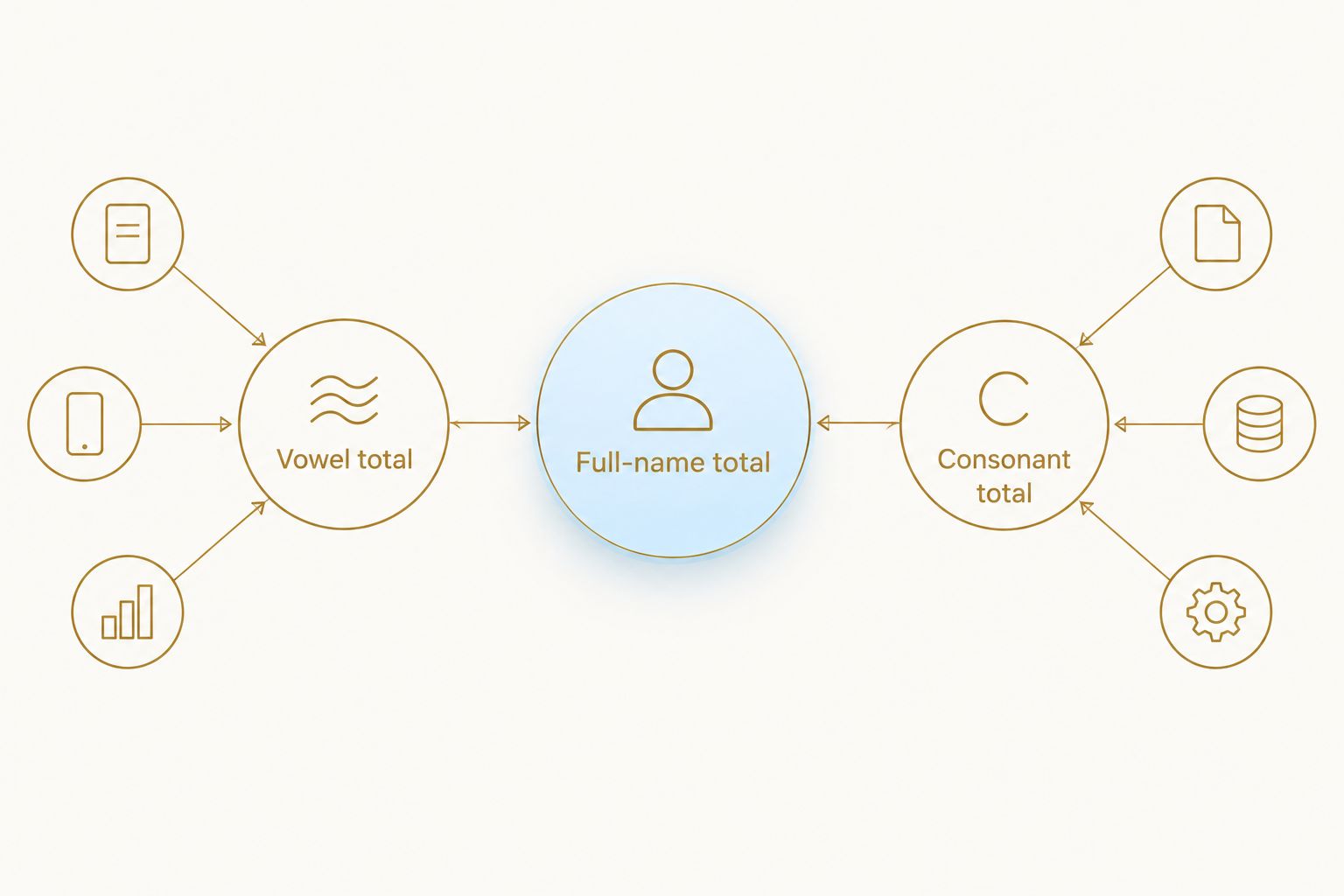
A breakdown calculator usually applies a name-number system to different groups of letters. In common Pythagorean terminology, vowels contribute to the Soul Urge or Heart's Desire number, consonants to the Personality number, and the full name to the Expression number.
Best for: You want to understand why a reading discusses inner motivation, outward presentation, and overall expression separately.
Return to the illustrative name ANNA LEE:
- Vowel total: A + A + E + E = 1 + 1 + 5 + 5 = 12; 1 + 2 = 3.
- Consonant total: N + N + L = 5 + 5 + 3 = 13; 1 + 3 = 4.
- Full-name total: 12 + 13 = 25; 2 + 5 = 7.
These are three views of one name under the same convention. They are not independent evidence that a personality description is accurate.
Vowel and consonant breakdown calculator pros:
- Separate totals make the reading's structure easier to follow.
- Subtotals provide an additional arithmetic check.
- Distinct labels discourage treating every number as the same concept.
Vowel and consonant breakdown calculator cons:
- Y requires a stated classification rule.
- Transliteration can change which letters enter the calculation.
- Additional interpretations can invite selective agreement with flattering descriptions.
Ask how Y is handled before comparing results. Do not assume that every calculator classifies the same spelling identically.
Verdict: Skip breakdowns that label results without showing which letters produced them.
4. Celestrio Self-Understanding Map: best for broader reflection
Celestrio is best for readers who want human-reviewed reflection across Pythagorean numerology, Western astrology, and Tu Vi rather than a standalone name total. The Self-Understanding Map brings these traditions together in one reading.
Best for: You have a question about recurring work, relationship, or life-change patterns and want context beyond name arithmetic.
Each tradition contributes a different perspective:
- Pythagorean numerology uses number conventions applied to names and birth dates.
- Western astrology interprets a birth chart based on birth date, time, and place.
- Tu Vi interprets a chart organized into palaces, or areas of life, using birth information within its own calendrical conventions.
Human review adds a person to the interpretation process. It does not turn these symbolic systems into scientific measurements, and agreement between them does not prove a conclusion.
Celestrio Self-Understanding Map pros:
- It brings the three traditions into one reading.
- Human review distinguishes it from an unexplained calculator output.
- Its reflective purpose fits questions that a name total alone cannot answer.
Celestrio Self-Understanding Map cons:
- It is not the direct choice for checking a name sum.
- More interpretive material requires careful separation of symbolism from evidence.
- A reading cannot make your decision or guarantee an outcome.
For example, turn a statement about independence into a question: do you prefer autonomy, or are you avoiding an uncomfortable conversation? Compare your answer with actual experiences rather than accepting the statement as a verdict.
Verdict: Hold until you can name the question you want the reading to help you explore.
How this ranking works
This 2026 ranking prioritizes visible calculation, clear conventions, and a distinct purpose for each option. Pythagorean full-name calculation comes first because its arithmetic is easy to demonstrate; Chaldean calculation serves tradition comparison; vowel and consonant breakdown serves interpretation.
A broader reading sits outside the calculator category. It becomes relevant when checking the sum no longer answers your question. This is a method-based comparison, not a claim that named websites underwent accuracy testing.
Check your inputs before interpreting your result
Write down the exact spelling you entered, including middle names. Record whether you used a birth name, current legal name, or commonly used name, according to the calculator's instructions.
Then save the letter values and original total. If another result differs, compare the inputs before comparing the descriptions. A missing middle name or a different treatment of Y is a calculation issue, not a mysterious contradiction.
For names outside the English alphabet, check how the calculator handles accents, non-Latin characters, and transliteration. Do not assume it preserves the original spelling or pronunciation.
Finally, keep your reason for using numerology separate from the result. If your question concerns a difficult relationship, a name number cannot replace a conversation about behavior, boundaries, and expectations.
Which numerology name calculator should you choose?
Choose a transparent Pythagorean full-name calculator as your default in 2026. It gives you a clear calculation to inspect before you decide whether its interpretation is useful.
Choose Chaldean calculation when that tradition is your actual interest, not because another result disappointed you. Choose a vowel and consonant breakdown when you want to understand the separate labels in a name reading.
Consider Celestrio numerology within the Self-Understanding Map when your purpose is broader self-reflection. Keep the standard unchanged: understandable reasoning, clear limitations, and your own judgment at the center.
FAQ
What's the best numerology name calculator in 2026?
A transparent Pythagorean full-name calculator is the best default for checking name arithmetic. Choose one that displays the exact spelling, letter values, total, and reduction rules.
Is Pythagorean numerology better than Chaldean numerology?
Neither tradition is established as a scientifically validated way to assess personality or predict outcomes. Pythagorean calculation is straightforward to reproduce; Chaldean calculation uses a different mapping and should be interpreted within its own conventions.
Should I enter my birth name or my married name?
Use the name specified by the calculator's method. If you compare different names, save each spelling and label the results separately rather than treating them as interchangeable.
Why do two name calculators give me different numbers?
Different inputs or conventions can produce different numbers. Compare the spelling, letter mapping, treatment of Y, master-number rules, and calculation label before reading either interpretation.
Is my name number the same as my Life Path number?
No. A name number uses letters, while a Life Path calculation uses a birth date; a calculator should identify which result it produces.
Can a numerology calculator tell me whether to change my name?
No calculator can establish that changing your name will improve your life. Treat the interpretation as a reflection prompt and consider your personal, cultural, and practical reasons separately.
Is the Self-Understanding Map just a name calculator?
No. The Self-Understanding Map brings Pythagorean numerology, Western astrology, and Tu Vi together in a human-reviewed reading, rather than only returning a name total.
One last thing
Before reading a number's meaning, write down a concrete question and a recent example from your life. Afterward, ask whether the interpretation helped you describe that example more clearly—or merely sounded agreeable.
That distinction protects the useful part of reflection. A reading earns its place by helping you ask a better question, not by taking the decision away from you.