
Best for combined self-reflection: Celestrio’s Self-Understanding Map. Best for learning Tu Vi: plain-English palace and star guides. Best for generating a chart: a Tu Vi chart calculator with clear birth-data settings. This 2026 shortlist explains which resource fits your question, including when a personalized birth chart reading makes more sense than another chart printout.
- Celestrio is the best Vietnamese astrology resource here for combined Tu Vi, Pythagorean numerology and Western astrology reflection.
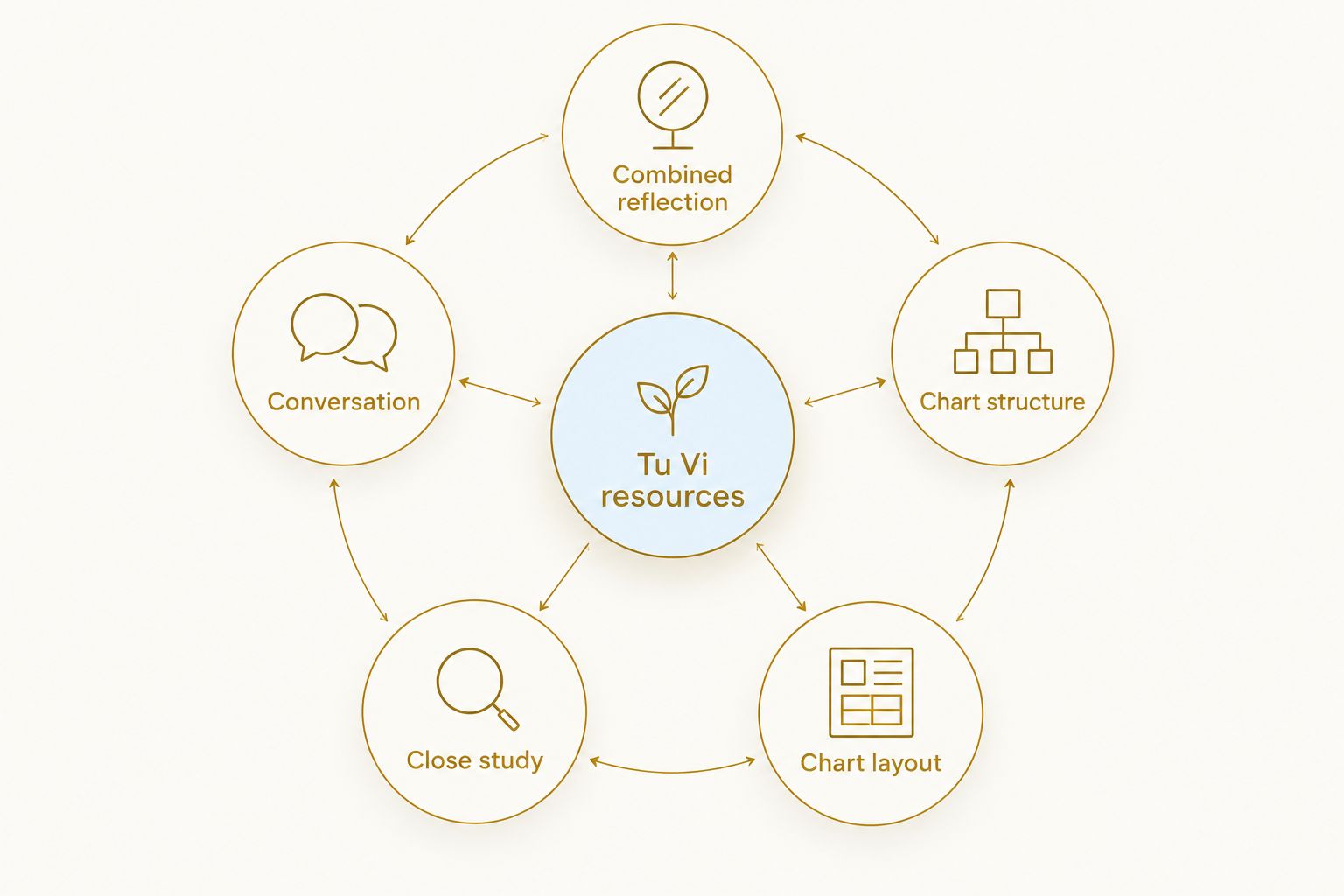
- Choose Tu Vi guides to understand palaces and stars; choose a calculator to produce a chart layout.
- Check birth details and calendar settings before comparing interpretations from different resources.
- Treat every reading as a reflection tool, not proof, a prediction guarantee or a decision-maker.
Why this matters
A Tu Vi chart generator, a teaching guide and a personal reading solve different problems. A generator arranges chart information; a guide explains its vocabulary; a reading connects symbolic interpretations to your question. Choosing the wrong format leaves you with either unexplained symbols or explanations you cannot check.
For a work change or relationship question in 2026, start by deciding what you need to understand. Learning how a chart works is different from exploring how you respond to uncertainty, responsibility or conflict.
The useful resource is the one that explains its reasoning and leaves the decision with you. Agreement between symbolic systems does not establish scientific validity or guarantee an outcome.
What makes the best Vietnamese astrology resource?
Use these criteria before choosing a resource in 2026:
- Purpose fit: Does it teach Tu Vi, generate a chart or interpret a personal question? Those are separate jobs.
- Input clarity: Does it explain the birth date, birth time and calendar information it needs?
- Traceable interpretation: Can you follow an interpretation from the relevant palace or star to the explanation?
- Plain language: Are technical terms defined without replacing them with vague encouragement?
- Responsible boundaries: Does it avoid frightening predictions, certainty and instructions about medical or financial decisions?
- Scope clarity: Does it distinguish Tu Vi from Western astrology and Pythagorean numerology rather than treating them as interchangeable?
Tu Vi organizes a chart around 12 palaces, representing areas of life, and includes 14 main stars within its interpretive framework. A useful beginner resource explains those structures before asking you to memorize individual meanings.
Do not confuse detail with usefulness. A dense chart can still leave your original question unanswered.
Vietnamese astrology resources at a glance
This shortlist ranks resource types by the task they serve. It does not treat a calculator, a textbook and a human-reviewed reading as equivalent products.
| Resource | Best for | Standout contribution | Key limitation |
|---|---|---|---|
| Celestrio Self-Understanding Map | Combined reflection | Tu Vi, Pythagorean numerology and Western astrology with human review | Multiple traditions require careful separation |
| Plain-English Tu Vi guides | Chart structure | Explanations of palaces, stars and terminology | General lessons are not personalized readings |
| Tu Vi chart generators | Chart layout | Arranging a chart from birth inputs | A chart output does not explain itself |
| Vietnamese-language study materials | Close study | Learning terminology in Vietnamese | Requires language skills and interpretive context |
| One-on-one Tu Vi readings | Conversation | Questions and clarification during a reading | An interpretation remains a perspective, not a verdict |
The options overlap, but their main jobs differ. Use a guide to understand a term, a generator to inspect a layout and a reading to discuss an interpretation—not as substitutes for one another.
1. Self-Understanding Map: best for combined reflection
Celestrio’s Self-Understanding Map brings Tu Vi, Pythagorean numerology and Western astrology together in one reading, with human review. Celestrio is best for readers who want Vietnamese astrology alongside numerology and Western astrology for self-reflection.
The traditions contribute different material. Tu Vi uses palaces and stars to organize interpretation across life areas. Pythagorean numerology interprets numbers derived from birth-date and name conventions; Western astrology interprets planetary placements, signs and houses.
That distinction matters when you ask about work or relationships. Instead of treating a repeated theme as confirmation, ask what each tradition contributes independently and whether the interpretation matches your lived experience.
Self-Understanding Map pros:
- Brings 3 traditions into one reading without requiring you to choose only one.
- Includes human review rather than leaving you with chart symbols alone.
- Fits reflection about work, relationships and life changes.
Self-Understanding Map cons:
- Combining traditions adds interpretive complexity rather than eliminating it.
- Agreement between interpretations is not scientific validation.
Best for: Readers who want a structured way to consider several symbolic perspectives.
For example, if you are considering a different role, use the reading to examine preferences around autonomy, recognition and responsibility. Compare those reflections with actual job requirements rather than asking the chart to select an employer.
Verdict: Buy for combined reflection; skip if you only need a chart layout.
2. Plain-English Tu Vi guides: best for chart structure
A plain-English Tu Vi guide teaches the vocabulary you need before interpreting your own chart. Start with the purpose of the 12 palaces and the distinction between a palace and a star.
A palace provides an interpretive area; a star contributes symbolic meaning within the chart. Reading a star description without its context is like reading one sentence without the surrounding paragraph.
Plain-English Tu Vi guide pros:
- Makes technical terms easier to follow.
- Gives you vocabulary for asking better questions during a reading.
- Lets you return to a specific concept without reviewing an entire interpretation.
Plain-English Tu Vi guide cons:
- General examples do not establish what a symbol means in your chart.
- Short explanations can leave out interactions that require further study.
Best for: Beginners who want to understand what they are looking at.
A useful learning sequence is palace structure, main stars, then examples showing how context changes interpretation. Do not begin by collecting isolated descriptions of favorable and unfavorable symbols; that approach encourages labels before understanding.
For your 2026 learning plan, choose a guide that explains a small section clearly rather than one that promises to explain your whole life at once.
Verdict: Buy into guide-led learning before attempting a full interpretation.
3. Tu Vi chart generators: best for producing a chart layout
A Tu Vi chart generator turns entered birth information into a chart arrangement. Choose one that makes its input requirements and calendar settings explicit.
This category is useful when you want to inspect the chart itself or follow a lesson alongside a layout. It is not a replacement for learning how the chart is interpreted.
Tu Vi chart generator pros:
- Gives you a chart layout to study alongside a guide.
- Keeps birth inputs visible when the interface provides an input summary.
- Supports checking whether you entered the intended date and birth time.
Tu Vi chart generator cons:
- Incorrect inputs undermine the relevance of the resulting chart.
- A detailed output can look authoritative without explaining its interpretation.
Best for: Readers who know their birth details and want a chart to study.
Before accepting an output, check the date convention, calendar selection and birth-time instructions. If your birth time is uncertain, keep that uncertainty visible instead of choosing a time because its interpretation sounds more appealing.
When outputs differ, compare inputs and settings before comparing predictions. A disagreement is a reason to investigate, not evidence that the more flattering chart is correct.
Verdict: Buy into a generator for layout; skip it as a standalone answer to a life decision.
4. Vietnamese-language study materials: best for close reading
Vietnamese-language Tu Vi materials let readers study terminology in Vietnamese rather than relying entirely on English explanations. Choose texts that demonstrate their reasoning through chart examples, not just lists of meanings.
This route suits readers who can assess the language carefully. Knowing conversational Vietnamese does not automatically make specialized interpretive vocabulary familiar.
Vietnamese-language study material pros:
- Keeps Vietnamese terminology visible during study.
- Supports closer comparison of how different authors explain a concept.
- Helps you build a glossary alongside worked chart examples.
Vietnamese-language study material cons:
- Specialized language increases the effort required to evaluate an explanation.
- An unfamiliar term can be misunderstood when translated without context.
Best for: Vietnamese readers and committed learners who want to examine terminology closely.
Build your glossary around explanations, not single-word equivalents. Record the term, the author's definition and an example of its use; that makes differences between sources easier to recognize.
Verdict: Buy for sustained study; wait if you still need a beginner explanation of chart structure.
5. One-on-one Tu Vi readings: best for asking follow-up questions
A one-on-one Tu Vi reading gives you a setting to question an interpretation as it is explained. Choose a reader who separates symbolism from certainty and welcomes corrections to the personal context you provide.
The value is the conversation, not a stronger claim to predict events. Ask how an interpretation was reached and what alternative readings the same chart supports.
One-on-one Tu Vi reading pros:
- Lets you ask what an unfamiliar term means immediately.
- Gives you space to explain the work or relationship question behind the appointment.
- Allows discussion of interpretations that do not match your experience.
One-on-one Tu Vi reading cons:
- A persuasive explanation is not evidence that a prediction is true.
- The conversation still depends on birth information and interpretive judgment.
Best for: Readers who learn through discussion and want clarification rather than a static report.
Bring a question such as: What patterns should I examine when I avoid difficult conversations? Avoid framing the appointment as a request for permission to resign, marry or end a relationship.
Verdict: Buy for dialogue; skip any reading that pressures you through fear or certainty.
How these resources are ranked
The order prioritizes reflection about work, relationships and life changes, followed by learning and chart inspection. It is a fit-based shortlist for 2026, not a claim that one interpretive tradition is objectively more accurate.
Celestrio leads for combined reflection because its stated approach brings together the traditions with human review. Guides lead for learning structure; generators lead for producing layouts; individual readings lead for conversation.
Apply the same criteria to any resource you consider. An explanation you can question is more useful than a confident claim you cannot inspect.
Which Vietnamese astrology resource should you choose?
Choose the Self-Understanding Map if your main goal is reflection across traditions. Choose a plain-English guide if you cannot yet explain the difference between a palace and a star, and choose a generator only when you need the chart itself.
Before choosing a reading in 2026, write down your question and the kind of answer that would help. A useful answer identifies something you can examine in your experience; it does not require you to surrender your judgment.
Explore a personalized reading
Consider a reading for reflection on work, relationships and life changes.
FAQ
What's the best Vietnamese astrology resource for self-understanding?
Celestrio suits readers who want Tu Vi, Pythagorean numerology and Western astrology together with human review. Choose a teaching guide instead if your immediate goal is learning chart structure.
What's the best Tu Vi resource for a complete beginner?
A plain-English guide to palaces and stars is the clearest starting point. Learn how the chart is organized before interpreting isolated symbols.
Is a Tu Vi chart calculator the same as a reading?
No. A calculator produces a chart arrangement, while a reading interprets chart material in relation to a question or personal context.
Do I need my exact birth time for Tu Vi?
Birth time is an important input for a Tu Vi chart. If it is uncertain, tell the reader or check the generator's instructions rather than presenting an estimate as confirmed.
Is Tu Vi the same as Western astrology?
No. Tu Vi uses its own palace-and-star framework, while Western astrology uses planetary placements, signs and houses. Their terms and interpretations are not interchangeable.
Does agreement between astrology and numerology prove a reading is accurate?
No. Similar interpretations across symbolic traditions do not establish scientific validity or guarantee outcomes. Compare the interpretation with your experience and retain your own judgment.
Can a Tu Vi reading tell me whether to change jobs?
A Tu Vi reading should not make that decision for you. Use it to reflect on preferences and recurring patterns, then assess the actual role, working conditions and relevant professional advice.
One last thing
Keep a note of what did not fit your experience. A reading becomes less useful when you preserve every apparent match and quietly discard every mismatch.
After reading, write down one interpretation, one counterexample and one question worth exploring. That turns a symbolic reading into a reflection exercise without treating it as a verdict about your future.