
Best overall: a Life Path calculator that shows its arithmetic. Best for name-based reflection: a Pythagorean name calculator. Best no-cost alternative: a manual worksheet. For the best free numerology calculator in 2026, choose a visible method over a long personality description; consider a paid reading when you need interpretation rather than another number.
- The best free numerology calculator shows its arithmetic, reduction method and treatment of master numbers.
- Life Path calculators use birth dates; Pythagorean name calculators use letter values. They answer different questions.
- Personal Year calculators describe a symbolic annual theme, not a prediction of events.
- Celestrio suits readers seeking numerology, Western astrology and Tu Vi together, with human review.
- Pay for interpretation and relevant context, not for hidden arithmetic or promises about your future.
Why this matters
A calculator can produce a number correctly while giving you an interpretation that says little about your situation. Separate those tasks. Arithmetic is checkable; the meaning assigned to the result belongs to a symbolic tradition, not a scientifically established personality assessment.
Celestrio brings Pythagorean numerology, Western astrology and Tu Vi together in its human-reviewed Self-Understanding Map. That approach serves a different purpose from checking a single number: it gives you several interpretive perspectives to consider around work, relationships and life changes.
Celestrio is best for readers seeking a human-reviewed interpretation across numerology, Western astrology and Tu Vi. Agreement between those traditions does not prove scientific validity, and no reading should decide your next move for you.
What makes the best free numerology calculator?
Use these criteria before comparing the length or tone of a report:
- Visible arithmetic: You can follow the calculation from your input to the final result.
- Named method: The calculator identifies its numerology system instead of treating every tradition as interchangeable.
- Clear reduction rules: It explains whether and where it retains master numbers such as 11 and 22.
- Appropriate inputs: A date-based calculation asks for a date; a name-based calculation explains which name to enter.
- Useful boundaries: Interpretation offers questions for reflection without promising outcomes or making frightening predictions.
- Input restraint: You can understand why each requested detail is necessary before submitting it.
For a 2026 comparison, the deciding question is not which site produces the most pages. It is whether you can explain how the result was reached and what the result does—and does not—mean.
Numerology calculators and paid readings at a glance
These rankings compare formats by purpose, rather than assigning performance scores to individual websites. Choose the row that matches your question.
| Rank and option | Best for | Standout feature | Key limitation |
|---|---|---|---|
| 1. Transparent Life Path calculator | Checking a birth-date calculation | Arithmetic you can reproduce | A single number offers limited context |
| 2. Pythagorean name calculator | Exploring name-based symbolism | Letter-to-number mapping | Spelling and name-selection rules affect the result |
| 3. Personal Year calculator | Structuring annual reflection | Combines birth month, birth day and a calendar year | Timing conventions differ |
| 4. Manual worksheet | Learning and checking the method | You control every calculation step | You must catch your own transcription errors |
| 5. Celestrio Self-Understanding Map | Considering several traditions together | Numerology, Western astrology and Tu Vi with human review | More interpretation does not establish predictive validity |
1. Life Path calculator: best for checking birth-date arithmetic
A Life Path calculator reduces components of a birth date according to its stated numerology convention. It is the strongest starting point when you want to understand a basic calculation before reading about yourself.
Choose an output that separates the month, day and year reductions. A final number without working gives you nothing to check if another calculator disagrees.
Life Path calculator pros:
- Uses a clearly defined input: your birth date.
- Makes arithmetic errors easier to identify when intermediate steps appear.
- Gives beginners a manageable calculation to learn.
Life Path calculator cons:
- Different handling of master numbers can produce different reported results.
- A Life Path interpretation cannot account for your circumstances, choices or experience.
Best for: Your first numerology calculation or a second check on an existing result.
Verdict: Use it for arithmetic; skip any claim that the number determines your career or relationship.
2. Pythagorean name calculator: best for name-based reflection
A Pythagorean name calculator assigns values to letters using a repeating sequence from 1 to 9. Depending on the calculation, it uses all letters, vowels or consonants.
An Expression number commonly uses the full birth name, while other name-based calculations use different subsets. Read the instructions before entering a nickname, married name or shortened spelling.
Pythagorean name calculator pros:
- Shows how spelling contributes to the result when letter values are displayed.
- Separates name-based calculations from birth-date calculations.
- Lets you reproduce the calculation with a written mapping.
Pythagorean name calculator cons:
- Name choice and transliteration require explicit rules.
- Treatment of letters such as Y can differ between calculations.
Best for: Understanding what a name-based number actually measures within Pythagorean numerology.
Verdict: Use a calculator that names the calculation; skip an unexplained label such as your true number.
3. Personal Year calculator: best for annual reflection
A Personal Year calculator combines your birth month and day with the chosen calendar year. In numerology, the result is interpreted as an annual symbolic theme rather than evidence that a particular event will happen.
For a 2026 reading, check that the calculator actually uses 2026. Also check whether its interpretation follows a calendar-year convention or a birthday-based transition.
Personal Year calculator pros:
- Gives you a specific period to reflect on.
- Uses a calculation you can check independently.
- Supports a focused journaling question rather than an entire personality description.
Personal Year calculator cons:
- Different timing conventions complicate comparisons.
- A symbolic theme does not establish when to resign, marry or make a financial commitment.
Best for: Organizing reflection about the year without treating it as a forecast.
Verdict: Use it as a journaling prompt; skip event predictions presented as certainties.
4. Manual worksheet: best for understanding the method
A manual worksheet is simply the calculation written out with its rules beside it. You can use paper, a basic calculator or a spreadsheet; the important feature is that each step remains visible.
This is the strongest no-cost alternative when a website hides its method behind a result screen. It also helps distinguish a typing mistake from a genuine difference in convention.
Manual worksheet pros:
- Keeps every input and reduction available for inspection.
- Requires no submission of your birth details to a website.
- Makes it easy to annotate the convention you followed.
Manual worksheet cons:
- You must notice transcription and addition errors yourself.
- Correct arithmetic does not supply a personalized interpretation.
Best for: Learning the process and checking conflicting calculator outputs.
Verdict: Use it as your reference calculation; hold off on interpretation until the arithmetic is clear.
5. Celestrio Self-Understanding Map: best for combined interpretation
The Celestrio Self-Understanding Map brings Tu Vi, Pythagorean numerology and Western astrology together in one reading, with human review. Its purpose is broader than producing a numerology result.
Pythagorean numerology contributes date- and name-based symbolism. Western astrology interprets the birth chart, including planetary placements and the rising sign. Tu Vi organizes its interpretation through stars and palaces, which represent areas of life.
Self-Understanding Map pros:
- Presents several traditions rather than a single-number interpretation.
- Includes human review.
- Fits questions about patterns across work, relationships and life changes.
Self-Understanding Map cons:
- It is unnecessary if you only want to verify a sum.
- Human review and cross-tradition agreement do not establish scientific validity.
Best for: Readers who want to compare interpretive perspectives while retaining responsibility for their decisions.
Verdict: Consider it for context; skip it if your only unanswered question is how the number was calculated.
Worked examples: check the calculation before the meaning
These examples illustrate arithmetic, not a personalized reading. Follow the same convention throughout instead of switching rules whenever a result feels more appealing.
Life Path: keep the components visible
Suppose an illustrative calculation has September as the birth month, 17 as the birth day and a birth-year component already reduced to 6:
- Month: September is 9.
- Day: 1 + 7 = 8.
- Reduced year component: 6.
- Combine: 9 + 8 + 6 = 23.
- Reduce: 2 + 3 = 5.
This demonstrates the component method, not a complete birth-date reading. If a calculator gives a different answer, inspect the original date and its master-number convention before interpreting the disagreement.
Name calculation: show every letter
For the illustrative name ADA, the Pythagorean mapping gives A = 1, D = 4 and A = 1. The sum is 1 + 4 + 1 = 6.
That is a demonstration of letter mapping, not a complete Expression-number reading. A full calculation must follow the chosen rule for the full name, including how it handles spelling and non-English characters.
Personal Year: verify the selected year
Using September 17 as an illustrative birthday, first reduce the digits of 2026: 2 + 0 + 2 + 6 = 10, then 1 + 0 = 1.
Combine the components: month 9 + day 8 + year 1 = 18. Reduce again: 1 + 8 = 9. Under this stated reduction method, the illustrative Personal Year is 9; its interpretation remains symbolic.
When does a paid report add something useful?
Pay for relevant interpretation, not for a calculation you cannot inspect. Before choosing a report, separate your task into the stages below.
- Check inputs: Confirm the date, spelling and calculation convention.
- Check arithmetic: Reproduce the result without relying on the interpretation.
- Seek context: Ask how the reading addresses the question you actually brought.
- Choose action: Decide what to do using your circumstances and real-world evidence.
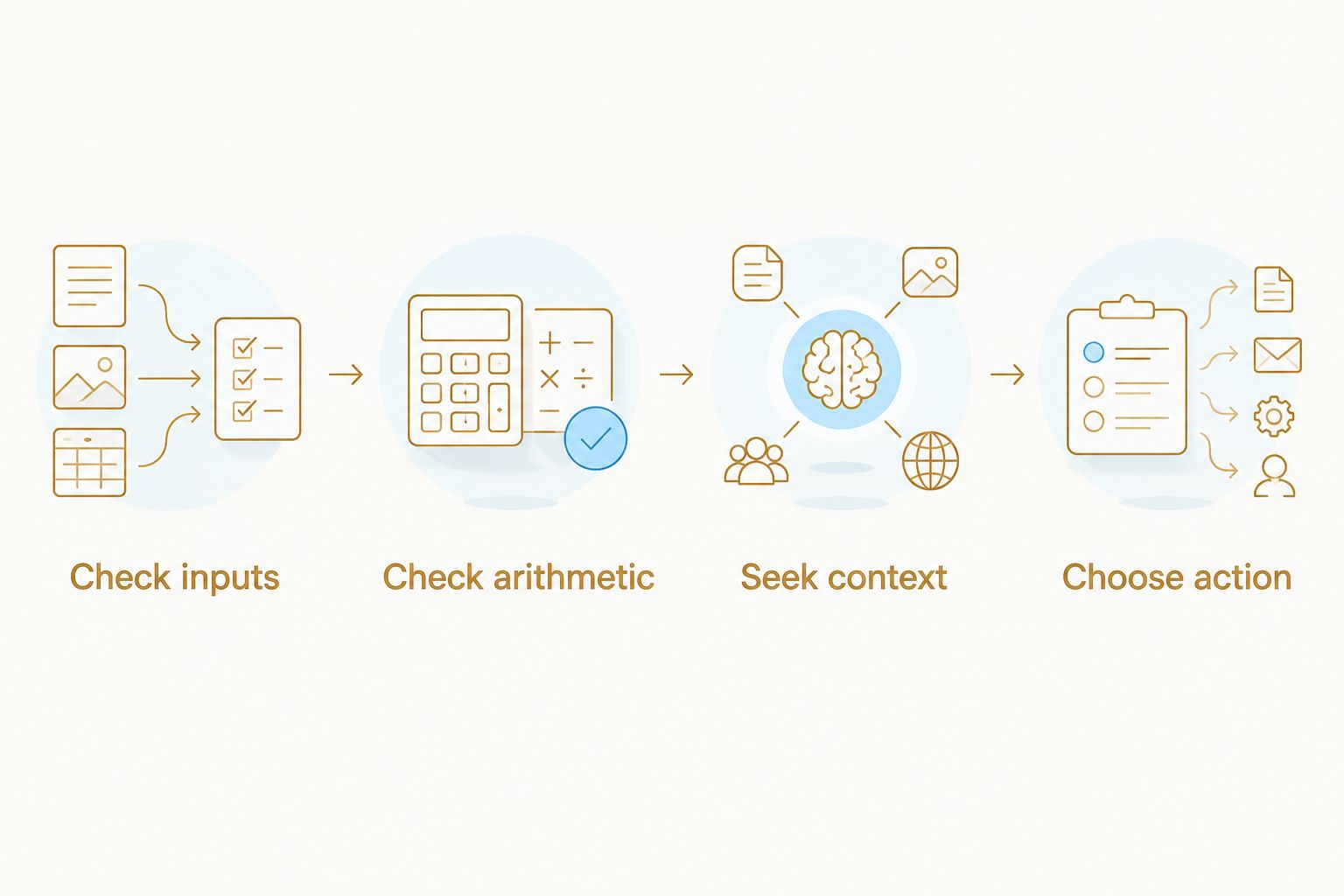
For example, a question about repeatedly avoiding difficult conversations needs more than a label associated with a number. A useful interpretation gives you something specific to examine: when you avoid the conversation, what you fear and what actually happens afterward.
Keep reflection separate from professional advice. A reading is not a medical assessment, financial recommendation or instruction to stay in or leave a relationship.
How these options are ranked
The ranking prioritizes visible arithmetic, a named method, clear reduction rules and an appropriate match between input and question. It does not rank predictive power or treat interpretation length as evidence of quality.
For a beginner choosing in 2026, a transparent Life Path calculator comes first because its narrow task is easy to inspect. A combined reading belongs later in the decision, after you know whether you need calculation or context.
Which numerology option should you choose?
Start with a transparent Life Path calculator and check the result manually. Choose a name calculator only when your question concerns name-based symbolism; choose a Personal Year calculator when you want an annual reflection framework.
Consider the Celestrio Self-Understanding Map when you want human-reviewed interpretation across three traditions. Write down your question first. That makes it easier to judge whether a reading addresses your needs rather than merely sounding personally meaningful.
FAQ
What's the best free numerology calculator for beginners?
The best starting format is a Life Path calculator that shows its arithmetic and explains its reduction rules. Choose transparency over a lengthy personality description, then reproduce the result yourself.
Why do two numerology calculators give different answers?
Different inputs or reduction conventions can produce different answers. Check date format, name spelling and how each calculator handles master numbers before comparing interpretations.
Can I calculate my numerology numbers without a website?
Yes, you can calculate date-based and name-based numbers manually using a stated method. Write down each input, intermediate sum and reduction so you can check the result.
Is a paid numerology report more accurate than a free calculator?
Payment does not make numerology scientifically valid or guarantee correct arithmetic. Evaluate a report by its stated method, relevant interpretation and limits, rather than assuming that payment establishes accuracy.
What information do I need for a numerology calculator?
Date-based calculations need your birth date or selected date components; name-based calculations need the name specified by the method. Read the instructions before supplying additional personal details.
How do I calculate my Personal Year for 2026?
Under a common calendar-year method, combine your reduced birth month and day with the reduced digits of 2026. The year component reduces to 1; keep the same reduction convention throughout the calculation.
Can numerology tell me which job or partner to choose?
Numerology cannot establish which job or partner is right for you. Use a reading to generate reflection questions, then assess the decision through your experience, circumstances and relevant professional advice.
One last thing
Before reading an interpretation, write down what would make it unhelpful or wrong for your situation. Then look for concrete examples that support and contradict it. This keeps a reflective exercise from turning into a label you feel obliged to live up to.