
Best overall: a component-reduction worksheet. Best for repeated calculations: a spreadsheet with visible formulas. Best for a quick cross-check: a straight digit-sum calculator. The best life path number calculator in 2026 shows its arithmetic and explains how it handles master numbers; a correct calculation does not establish that its interpretation predicts your life.
- The best life path number calculator shows its method, intermediate totals, and master-number rules.
- Component reduction is the clearest starting point; a visible-formula spreadsheet suits repeated calculations.
- Different calculation conventions can produce different master-number labels without changing the underlying single-digit result.
- Celestrio's Self-Understanding Map combines three traditions with human review; use it for reflection, not prediction.
Why this matters
A life path calculator turns your birth date into a numerology number. That sounds straightforward until two calculators give different answers, especially when one preserves 11, 22, or 33 and another reduces those numbers further.
Calculation accuracy means following a stated rule correctly. It does not mean the resulting personality description is scientifically validated. Keep those questions separate when choosing a calculator or evaluating a reading.
Celestrio brings Pythagorean numerology, Western astrology, and Tu Vi together in its Self-Understanding Map, with human review. Understanding the arithmetic first helps you judge whether a reading explains your inputs clearly rather than simply giving you a description that sounds familiar.
What makes the best life path number calculator?
Use these criteria for your 2026 shortlist:
- Visible arithmetic: You can see the original date, intermediate totals, and final reduction.
- Declared method: The calculator says whether it reduces date components separately or adds every digit together.
- Master-number rules: It explains whether it preserves 11, 22, and 33, and at which calculation stages.
- Clear date entry: Month, day, and year have unambiguous labels; the tool does not make you guess the date format.
- Limited interpretation: The explanation presents numerology as a reflective tradition, not proof of your abilities or future.
- Reproducible results: You can repeat the calculation by hand and explain any difference from another tool.
A long report is not evidence of better arithmetic. Neither is a confident description. Prefer a short calculation you can inspect over a detailed interpretation whose method remains hidden.
Life path calculator options at a glance
These are ranked calculation approaches, not an unverified leaderboard of websites. The ranking concerns transparency and ease of checking, not predictive power.
| Rank | Option | Best for | Standout feature | Key limitation |
|---|---|---|---|---|
| 1 | Component-reduction worksheet | Understanding your first calculation | Shows month, day, and year separately | Requires a stated master-number convention |
| 2 | Visible-formula spreadsheet | Repeating the same method across dates | Makes calculation rules reusable | Incorrect formulas repeat incorrect results |
| 3 | Straight digit-sum calculator | Checking the underlying reduction | Short calculation you can reproduce | Can produce a different master-number label |
All three approaches can perform correct arithmetic. The deciding question is whether the method matches the convention you intend to use.
1. Component-reduction worksheet: best for learning the method
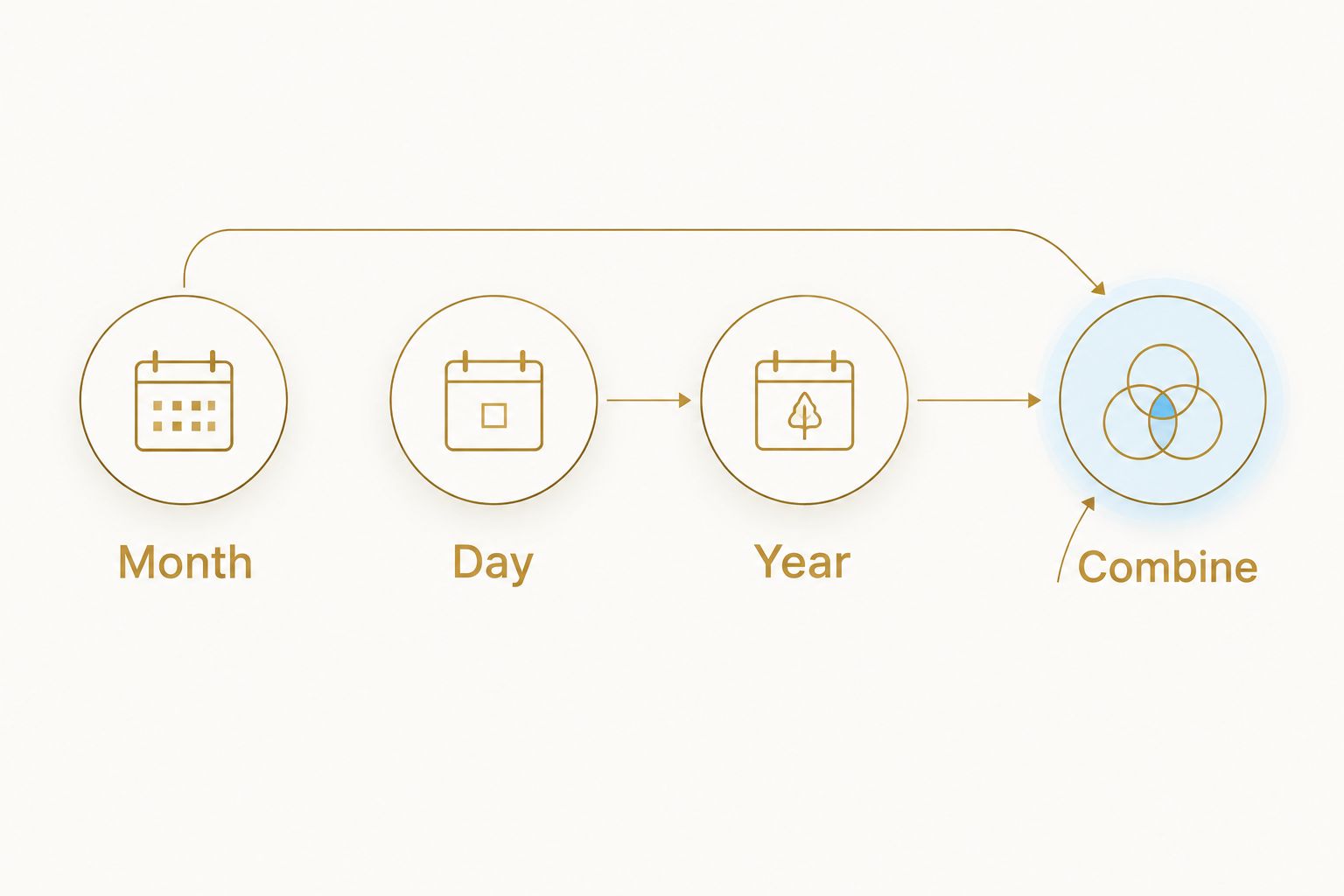
A component-reduction worksheet reduces the month, day, and year separately, then combines those results. It is the strongest default because you can inspect each stage without needing to understand spreadsheet formulas.
Best for: Your first life path calculation, or any situation where you want to understand why a result appeared.
A worked component-reduction example
Use April 17, 2026 as an illustrative test date. This is an arithmetic example, not a personalized reading or a description of an adult's life.
For this example, reduce the 3 date components separately, preserve master numbers when encountered, and then reduce the combined total:
- Month: April is month 4, so the month value is 4.
- Day: 17 becomes 1 + 7 = 8.
- Year: 2026 becomes 2 + 0 + 2 + 6 = 10, then 1 + 0 = 1.
- Combine: 4 + 8 + 1 = 13.
- Reduce: 1 + 3 = 4.
The result under this stated component-reduction convention is 4. Nothing in those steps establishes a personality trait; the calculation and its symbolic interpretation are separate.
Component-reduction worksheet pros
- You can locate an arithmetic error at the stage where it occurs.
- The separate date components make the method understandable.
- You can record the master-number convention beside the result.
Component-reduction worksheet cons
- Manual addition leaves room for transcription errors.
- Different instructions can preserve master numbers at different stages.
- The worksheet does not explain what a symbolic interpretation should mean in your circumstances.
Verdict: Use a component-reduction worksheet as your default. Keep the intermediate totals, not just the final number.
2. Visible-formula spreadsheet: best for repeated calculations
A spreadsheet can apply the same component-reduction method across multiple dates. Its advantage is consistency: the rules remain visible and reusable rather than being hidden behind a result screen.
Best for: Checking several dates using one declared convention, including an exploratory comparison between partners.
What the spreadsheet should show
Give the sheet separate columns for the entered date, reduced month, reduced day, reduced year, combined total, and final result. Add a note explaining which master numbers the formulas preserve.
Use the April 17, 2026 example as a test before entering personal dates. A spreadsheet implementing the component method above should show month 4, day 8, year 1, combined total 13, and final result 4.
Also inspect how the sheet handles dates. A date displayed differently from the one you entered signals a problem to resolve before interpreting anything.
Visible-formula spreadsheet pros
- The same calculation convention applies to every row.
- Intermediate columns reveal where a result comes from.
- You can compare a formula result with a handwritten calculation.
Visible-formula spreadsheet cons
- A formula error can affect every subsequent calculation.
- Date formatting can change how an entry is read.
- Hidden formulas or unexplained exceptions remove the transparency advantage.
Verdict: Use a visible-formula spreadsheet for repetition, but verify it by hand first. Automation improves consistency only after the underlying rule is correct.
3. Straight digit-sum calculator: best for a quick cross-check
A straight digit-sum calculator adds every digit in the full birth date before reducing the total. It is easy to reproduce, but its treatment of master numbers can differ from a component-reduction worksheet.
Best for: Checking the underlying single-digit reduction and understanding why another calculator gives a different label.
The same date, a different label
For April 17, 2026, add the date's digits directly:
4 + 1 + 7 + 2 + 0 + 2 + 6 = 22.
A straight digit-sum calculator that preserves a final 22 reports 22, often written 22/4 to show its single-digit reduction. A calculator that continues reducing reports 2 + 2 = 4.
The component worksheet above also produces 4, but it does not encounter 22 in its final total. This example explains why a master-number disagreement does not automatically mean someone made an addition error.
Straight digit-sum calculator pros
- The calculation is short enough to repeat without a specialist tool.
- You can inspect the full addition in one line.
- It helps distinguish an arithmetic disagreement from a convention disagreement.
Straight digit-sum calculator cons
- Its master-number label can differ from component reduction.
- A bare result hides whether the calculator stopped at a master number.
- It provides less detail about the separate date components.
Verdict: Use straight digit-sum as a cross-check, not an interchangeable replacement for every other convention. Name the method whenever you share the result.
How these options are ranked
The ranking prioritizes visible arithmetic, a declared method, clear master-number rules, and reproducibility. Component reduction comes first because its separate stages make an initial calculation easy to follow; spreadsheets come second because they require formula checking.
Straight digit-sum comes third as a useful comparison method, not because its addition is less accurate. This 2026 guide does not rank predictive performance or claim that any approach has demonstrated an ability to forecast life events.
What to do when calculators disagree
Compare the calculation records before reading either interpretation. Use this sequence:
- Check the date: Confirm that both tools received the same month, day, and year.
- Check the method: Identify component reduction versus straight digit-sum.
- Check the stopping rule: Find out where each tool preserves master numbers.
- Check the arithmetic: Recalculate each displayed stage.
If a calculator explains none of these, set its interpretation aside. You cannot meaningfully assess a result when you cannot reconstruct how it was obtained.
Do not choose whichever label sounds more flattering. Choose a convention, document it, and apply it consistently.
From a life path number to useful self-understanding
A number alone cannot tell you whether to leave a job, end a relationship, or make a major commitment. Those decisions require your circumstances, preferences, responsibilities, and evidence from actual experience.
For example, suppose a numerology interpretation associates your result with structure. Instead of treating that as a fixed identity, ask: When does planning help me, and when does it become avoidance? Write down an example that supports the description and another that contradicts it.
Celestrio's Self-Understanding Map is best for readers who want numerology considered alongside Western astrology and Tu Vi, with human review. That is a different purpose from checking a calculator's arithmetic.
The traditions contribute different material:
- Pythagorean numerology: Uses numerical reductions, including birth-date calculations, as a symbolic framework for reflection.
- Western astrology: Interprets a birth chart; birth time affects the rising sign and house placements.
- Tu Vi: Uses a chart organized into 12 palaces, interpreted through its star system and birth information.
Agreement between traditions does not prove scientific validity. A useful reading explains each framework, distinguishes interpretation from fact, and leaves the decision with you.
If recurring patterns are your main interest, the personalized birth chart reading is relevant to that question. When evaluating Celestrio's life path number guidance, look for an explanation of the calculation as well as the broader interpretation; human review is not a guarantee of outcomes.
Which life path calculator should you choose?
Choose a component-reduction worksheet if you are undecided. It gives you an inspectable starting point and makes master-number conventions easier to discuss.
Choose a visible-formula spreadsheet when you need to repeat that method. Choose straight digit-sum when you want to investigate a different label or check the underlying reduction.
For your 2026 decision, prioritize an explanation you can reproduce over a report you cannot question. A calculator should answer how the number was obtained before asking you to attach meaning to it.
FAQ
What's the best life path number calculator for a beginner?
A component-reduction worksheet is the clearest starting point because it shows the month, day, and year calculations separately. Choose instructions that explicitly state how master numbers are handled.
Why do two life path calculators give me different numbers?
Different calculation methods or master-number rules can produce different labels. Compare the entered date, intermediate totals, and stopping rules before assuming the arithmetic is wrong.
Should my life path calculator keep 11, 22, and 33?
Your calculator should state whether it preserves 11, 22, and 33 and at which stages. Numerology conventions differ, so an unexplained master-number result is not enough to judge the calculation.
Do I need my birth time to calculate my life path number?
You do not need birth time for a birth-date life path calculation. Birth time serves a different purpose in Western astrology and Tu Vi chart construction.
Does my life path number change in 2026?
Your life path number does not change each year under the same calculation convention because your birth date stays the same. A personal year number is a different numerology calculation.
Does an accurate life path calculation prove numerology works?
Correct arithmetic does not establish that numerology predicts personality or events. Use the interpretation as a prompt for reflection, not as a diagnosis or a substitute for professional advice.
Is Celestrio's Self-Understanding Map the same as a life path calculator?
Celestrio's Self-Understanding Map combines Pythagorean numerology, Western astrology, and Tu Vi with human review. A life path calculator performs a narrower task: reducing a birth date according to a stated convention.
One last thing
Save the calculation beside the interpretation. A result written as 4, component reduction tells you more than an unexplained 4; a result written as 22/4, straight digit-sum preserves the convention behind the label.
That small habit makes future comparisons clearer. You are checking an explicit method, not trying to decide which description feels most convincing.