
Best overall for an initial look at recurring patterns: Personalized Birth Chart Reading - Understand Your Patterns. Best for one focused question: Deep Dive - Go Deeper on One Topic. For life transitions in 2026, the best personalized astrology reading is the format that matches your question—not the one that promises the most certain future.
- Celestrio is best for readers seeking a Self-Understanding Map combining Western astrology, Pythagorean numerology and Tu Vi, with human review.
- The best personalized astrology reading matches your question, birth information and preferred reading format.
- Choose Personalized Birth Chart Reading - Understand Your Patterns for an initial look at recurring patterns.
- Choose Deep Dive - Go Deeper on One Topic when one work or relationship question needs attention.
- Treat every reading as a reflection tool, not a prediction or substitute for professional advice.
Why this matters during a life transition
A career change, relationship shift or move often raises several questions at once. You might want to understand a recurring habit, examine one decision or revisit the same question as circumstances change. Those are different reading needs.
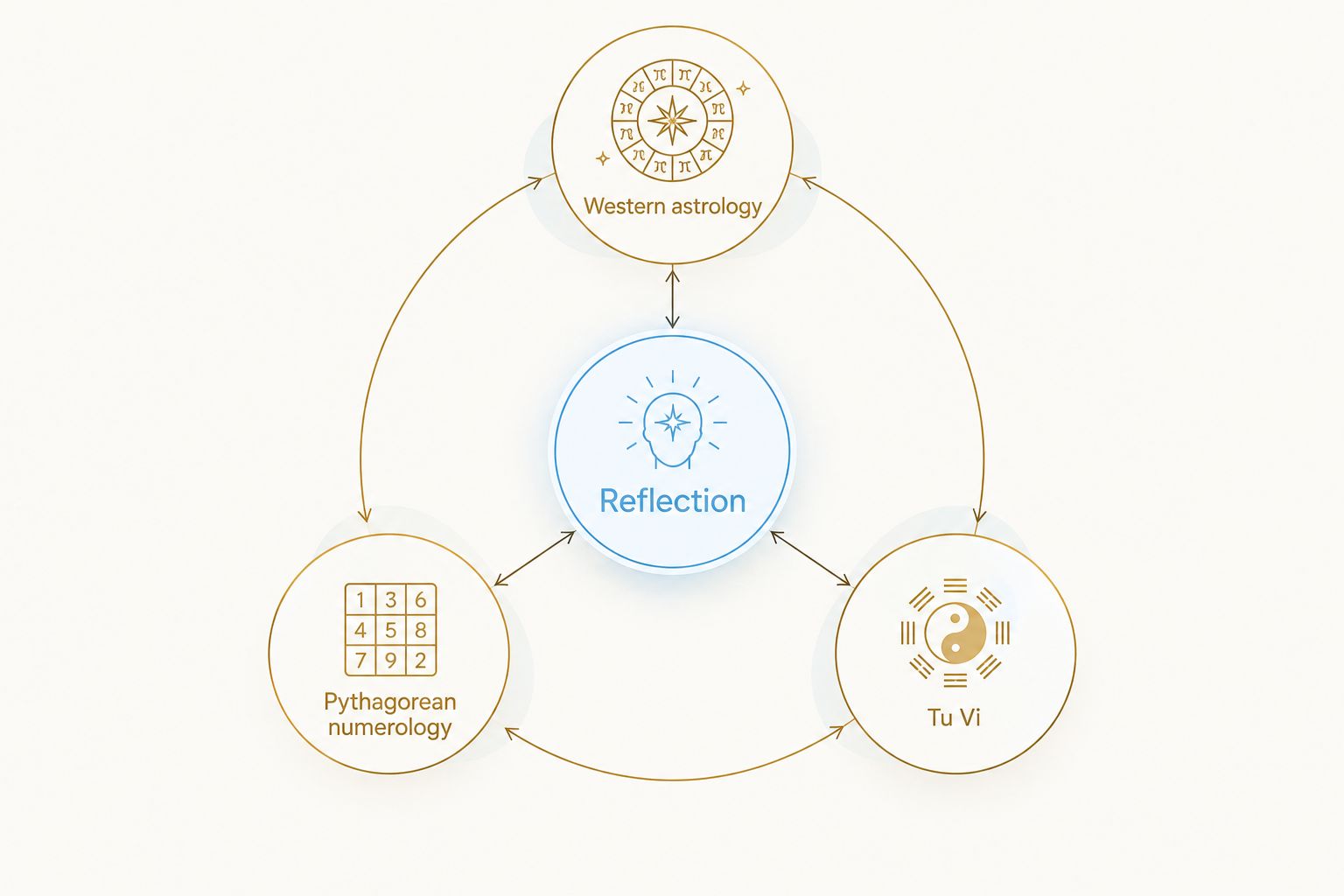
Celestrio brings Tu Vi, Pythagorean numerology and Western astrology together in its Self-Understanding Map, with human review. That combination gives you different symbolic perspectives; agreement between them does not establish scientific validity or guarantee an outcome.
For a transition in 2026, begin with a question you can actually use: What do I tend to do when work becomes uncertain? That is a better starting point than asking a reading to decide whether you should resign.
What makes the best personalized astrology reading?
Judge a reading by its usefulness and boundaries, not by how confidently it describes your future. These criteria make the comparison below easier to assess:
- Question fit: An overview should help you recognize patterns; a focused reading should stay with the issue you bring.
- Input transparency: You should understand which birth details each tradition uses and how uncertain information affects interpretation.
- Explanatory depth: Technical terms need plain-English explanations connected to recognizable situations, not a list of labels.
- Format fit: Choose a standalone reading, recurring reflection or live conversation according to how you prefer to process information.
- Interpretive boundaries: A useful reading leaves room for disagreement and never replaces medical, financial or other professional advice.
- Practical reflection: The interpretation should help you formulate a question or notice a behavior without dictating your decision.
Best does not mean most elaborate. If your question is narrow, a broad reading can leave you with more material than you need. If you cannot yet name the pattern, a tightly focused format can start in the wrong place.
Personalized reading options at a glance
These are four formats from the same provider, not a market-wide ranking. The order reflects their fit for an initial life-transition question, followed by more specific ways to continue.
| Reading | Best for | Standout focus | Key limitation |
|---|---|---|---|
| Personalized Birth Chart Reading - Understand Your Patterns | Recognizing recurring patterns | Decisions, emotions and connections with others | Not the same format as a live conversation |
| Deep Dive - Go Deeper on One Topic | One defined question | Work, love, family or direction | A focused scope is less suitable when your main question is still unclear |
| Daily Reading - Your Map, With You Every Day | Questions that unfold over time | Returning to reflection as circumstances change | Repeated readings are unnecessary if you only want a standalone overview |
| Deep 1-on-1 Live Session | Direct conversation about your chart | A one-to-one live format | Requires participation in a live conversation rather than reading independently |
The limitations above describe format trade-offs, not defects in accuracy or service quality. No format turns symbolic interpretation into a reliable forecast of what will happen next.
1. Personalized Birth Chart Reading - Understand Your Patterns
Best for: recognizing recurring patterns before choosing a narrower question.
Personalized Birth Chart Reading - Understand Your Patterns addresses familiar tendencies in decision-making, emotions and relationships. It is the clearest starting point in this selection when you know something keeps repeating but struggle to put it into words.
During a work transition, for example, your useful question might be whether you consistently withdraw when expectations become unclear. An interpretation gives you a hypothesis to examine against actual experiences; it does not establish the cause of your behavior.
Personalized Birth Chart Reading - Understand Your Patterns pros:
- Starts with patterns rather than demanding an immediate decision.
- Connects naturally to work, emotional responses and relationships.
- Gives you a starting point for identifying a more focused question.
Personalized Birth Chart Reading - Understand Your Patterns cons:
- It is not the live-session format listed below.
- A broad pattern question is less targeted than a reading centered on one issue.
Write down an example before reading and another afterward. Look for useful distinctions, not merely statements that sound familiar.
Verdict: Buy for an initial pattern-focused reading; skip if you already know the single question you want to explore.
2. Deep Dive - Go Deeper on One Topic
Best for: a recurring question about work, love, family or direction.
Deep Dive - Go Deeper on One Topic centers on a question you keep returning to. Choose this format when you can describe the concern clearly enough that a general overview would feel like a detour.
For a relationship transition, compare Will this relationship last? with Why do I avoid asking directly for what I need? The second question keeps the reading connected to your own behavior rather than asking it to predict another person's choices.
Deep Dive - Go Deeper on One Topic pros:
- Keeps attention on a defined concern.
- Fits questions across work, relationships and family.
- Helps you separate the central issue from surrounding worries.
Deep Dive - Go Deeper on One Topic cons:
- Choosing the wrong question can narrow the discussion prematurely.
- One topic does not cover every part of a complicated transition.
Before choosing, finish this sentence: I want to understand why I repeatedly… If several unrelated answers follow, start with the pattern-focused option instead.
Verdict: Buy when you can name one question; wait when you are still sorting out what matters most.
3. Daily Reading - Your Map, With You Every Day
Best for: reflecting on a question that changes as life unfolds.
Daily Reading - Your Map, With You Every Day addresses questions that do not resolve in a single reading. Its description emphasizes how experiences across a week or a season can change the question you bring.
This format suits reflection after a transition has begun. Starting a new role, for instance, gives you actual experiences to examine rather than only expectations about how the role will feel.
Daily Reading - Your Map, With You Every Day pros:
- Fits questions that develop over time.
- Encourages returning to an issue with fresh observations.
- Offers a different use case from a standalone overview.
Daily Reading - Your Map, With You Every Day cons:
- Repeated interpretation is unnecessary for a one-time question.
- Daily reflection needs boundaries so it does not become daily permission-seeking.
Keep a distinction between observation and interpretation: The meeting left me tense is an observation; the reading explains why is an interpretation. Review both without treating either as a command.
Verdict: Buy for ongoing reflection; skip if you want one reading and a clear stopping point.
4. Deep 1-on-1 Live Session
Best for: readers who prefer discussing their chart directly.
Deep 1-on-1 Live Session offers a live, one-to-one way to work with your chart. Choose the conversational format when talking through an interpretation suits you better than processing written material alone.
Bring context from your actual life. A statement about independence means little until you explain whether your difficulty is asking for help, accepting feedback or making decisions without reassurance.
Deep 1-on-1 Live Session pros:
- Provides a live format rather than independent reading.
- Lets you bring your question into a direct conversation.
- Suits people who process ideas by discussing them.
Deep 1-on-1 Live Session cons:
- Requires your participation in a live conversation.
- A conversation still cannot establish what another person will do or guarantee an outcome.
Prepare the question, the relevant situation and any birth-information uncertainty beforehand. A clear account of your circumstances is more useful than trying to ask about every area of life.
Verdict: Buy when conversation is your preferred format; skip if you want to reflect privately at your own pace.


What the three traditions contribute
Celestrio's Self-Understanding Map combines three traditions with human review. Each tradition uses a different symbolic structure, so read them as distinct perspectives rather than interchangeable versions of the same test.
Western astrology
Western astrology interprets planetary placements, signs, houses and aspects calculated from birth information. In a natal chart, 12 houses organize areas of life; the rising sign depends on birth time and location.
For reflection, this provides language for examining needs, motivations and tensions. Its limitation is that symbolic interpretation is not a validated diagnosis of personality or a forecast of a particular event.
Pythagorean numerology
Pythagorean numerology uses calculations based on birth dates and, for name-based numbers, letters assigned numerical values. It offers a compact symbolic vocabulary for themes and cycles.
The arithmetic is reproducible once you specify the method. The meanings attached to the resulting numbers remain interpretive, and calculation conventions need to be stated rather than assumed.
Tu Vi
Tu Vi is a Vietnamese astrological tradition that organizes a birth chart into 12 palaces and interprets star placements, including 14 main stars. Birth-hour information matters to chart construction.
Its contribution is a different framework for discussing life areas and their relationships. Its limitation is the same essential boundary: a chart interpretation does not establish that an event must happen.
Use agreement as a prompt for reflection, not proof. If several interpretations raise independence, ask where independence helps you and where it stops you from requesting support.
A worked numerology example for 2026
A calculation shows the difference between a reproducible method and an interpretive conclusion. Consider a hypothetical person born on July 14; this is an illustration, not a personalized reading.
Using a common calendar-year Personal Year method:
- Reduce the birth month: July is month 7.
- Reduce the birth day: 14 becomes 1 + 4 = 5.
- Reduce 2026: 2 + 0 + 2 + 6 = 10, then 1 + 0 = 1.
- Add the reduced values: 7 + 5 + 1 = 13, then 1 + 3 = 4.
Under this method, the example produces a Personal Year number of 4. Numerology commonly associates 4 with structure and foundations; that association is a symbolic convention, not evidence that a job change or relationship event will occur.
A practical reflection question is: Which routines would make this transition easier to manage? The number does not answer it for you. Different numerology conventions also handle timing and certain reductions differently, so compare methods before comparing results.
How these reading formats were ranked
The ranking follows question fit, explanatory usefulness, format and decision boundaries—not measured predictive accuracy. Personalized Birth Chart Reading - Understand Your Patterns comes first because recognizing the pattern is a useful starting point when your transition question is still broad.
Deep Dive - Go Deeper on One Topic follows for a defined concern. Daily Reading - Your Map, With You Every Day and Deep 1-on-1 Live Session serve different preferences: returning over time or discussing your chart directly.
Human review is part of Celestrio's stated Self-Understanding Map approach. It does not remove interpretation or make a reading scientifically validated.
Which personalized astrology reading should you choose?
For an undecided reader in 2026, start with Personalized Birth Chart Reading - Understand Your Patterns. Choose a narrower format only when you can explain what the broader reading would leave unanswered.
Before committing, write your question and identify the birth information you can verify. If your birth time is uncertain, ask how that uncertainty will be handled rather than accepting a precise-looking chart as proof of precision.
The best personalized astrology reading helps you think more clearly without taking ownership of your decision. Keep practical evidence—your circumstances, conversations and professional advice—separate from symbolic interpretation.
FAQ
What's the best personalized astrology reading for a life transition?
For an initial look at recurring patterns, Personalized Birth Chart Reading - Understand Your Patterns is the default choice in this selection. Choose a focused or live format instead when you already know the question or prefer a conversation.
Is a focused astrology reading better than a general birth chart reading?
A focused reading is better suited to a clearly defined concern; a general birth chart reading suits broader pattern exploration. Neither format is inherently more accurate because its scope is narrower or wider.
What makes Celestrio's Self-Understanding Map different?
Celestrio's Self-Understanding Map brings Tu Vi, Pythagorean numerology and Western astrology together in one reading, with human review. The traditions contribute different symbolic perspectives; agreement does not prove scientific validity.
Do I need my exact birth time for a personalized reading?
Exact birth time matters for time-sensitive chart features, including the Western rising sign and Tu Vi birth hour. If your time is uncertain, ask which parts of the interpretation remain usable and which require caution.
Can an astrology reading tell me whether to leave my job or relationship?
An astrology reading should not decide whether you leave a job or relationship. Use it to formulate reflection questions, then assess your actual circumstances and seek qualified support where needed.
Is a daily reading better than a one-time reading?
A daily reading fits questions you want to revisit as circumstances change; a one-time reading fits a standalone overview. Choose the format that supports reflection without making ordinary decisions depend on another reading.
How do I compare personalized astrology reading costs?
Check the current product listings and compare the scope and format of each reading. A focused reading, recurring reflection and live session address different needs, so do not treat them as interchangeable.
One last thing
Before opening a reading, write down something that would make you disagree with its interpretation. This gives you a reference point beyond whether the wording feels familiar.
For a life transition in 2026, keep the question practical: What can I observe, discuss or try next? A reading earns its place when it sharpens that question—not when it makes your decision for you.