
Best overall for an integrated reading: Celestrio’s Self-Understanding Map. Best for a narrower comparison: a two-system written reading. Best for learning the methods yourself: separate charts and calculations. Best for asking follow-up questions: a live consultation. This 2026 guide compares reading formats, not competing providers; Celestrio brings Tu Vi, Pythagorean numerology and Western astrology together with human review.
- Celestrio’s Self-Understanding Map is the best combined astrology numerology reading here for integrated, human-reviewed reflection.
- Western astrology, Pythagorean numerology and Tu Vi use different inputs and interpretive frameworks.
- Choose a written reading for revisiting themes; choose a live consultation for questions and clarification.
- Agreement between traditions does not establish scientific validity or guarantee an outcome.
Why this matters
A combined reading should do more than place unrelated descriptions in the same document. You need to see which tradition produced each interpretation, where the interpretations differ, and how to turn those differences into useful questions.
That matters when you are considering a job change, noticing a recurring relationship pattern, or trying to describe what feels unsettled. A reading can provide language for reflection. It cannot establish what another person thinks or decide what you should do.
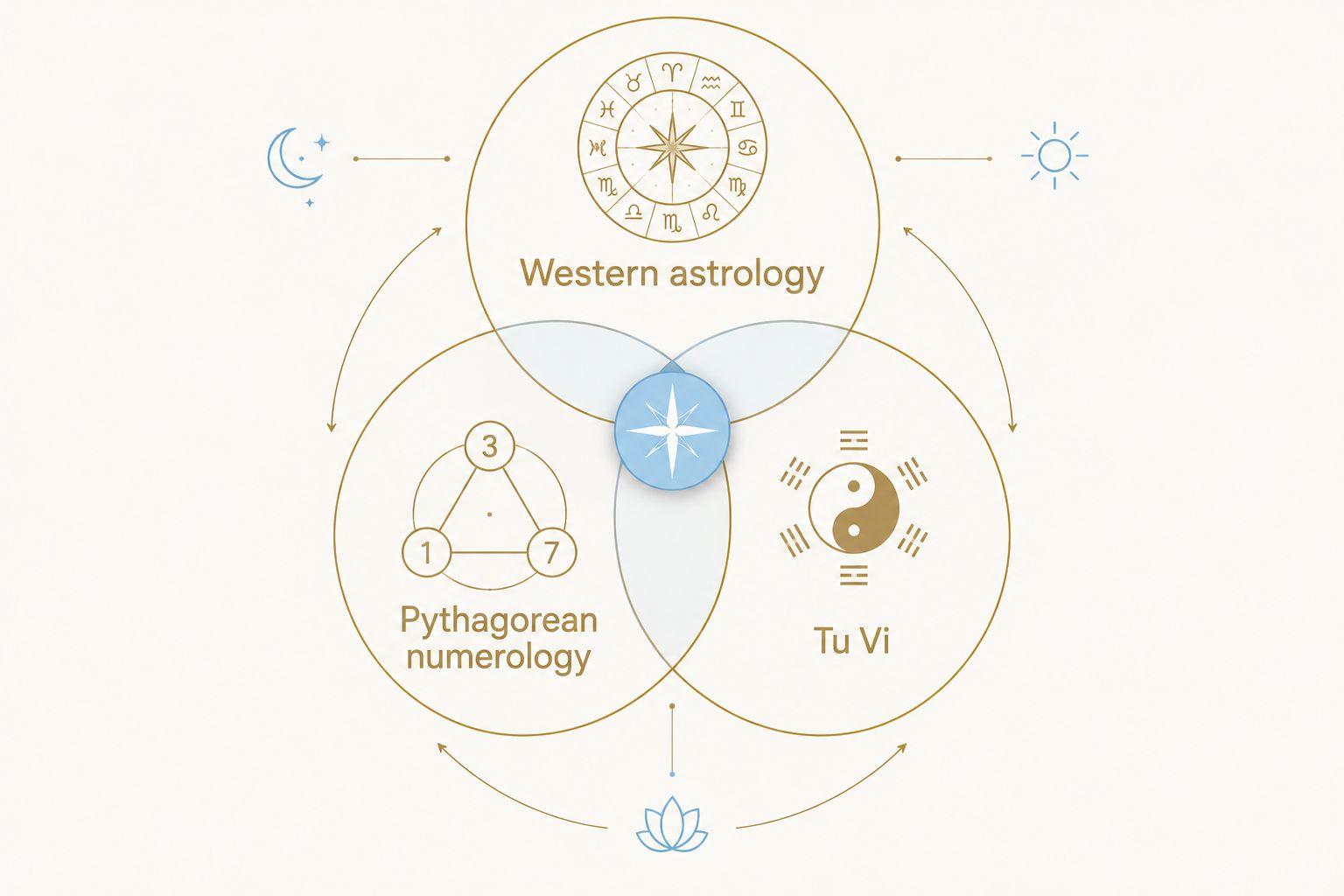
Celestrio’s Self-Understanding Map is best for people who want Western astrology, Pythagorean numerology and Tu Vi interpreted together with human review. That is a recommendation about format and scope, not evidence that these traditions predict events.
What makes the best combined astrology numerology reading?
Use these criteria when comparing a reading in 2026. A long report is not automatically a useful one.
- Named methods: The description should identify the traditions used, rather than promise an unexplained blend of insights.
- Traceable inputs: You should understand which conclusions come from your birth chart, birth-date calculations, name calculations or Tu Vi chart.
- Integration: The interpretation should explain connections and disagreements instead of repeating broad personality descriptions.
- Relevant scope: A reading about work patterns should address work questions, not substitute a general relationship description.
- Interpretive accountability: Human review should clarify the reading without turning symbolic interpretations into factual verdicts.
- Decision boundaries: The reading should leave choices with you and avoid frightening predictions, guarantees or professional-advice substitutes.
Before choosing, write your question in ordinary language. For example: “I keep accepting responsibility and then feeling trapped. What patterns should I examine?” That gives a reader something clearer to address than “Tell me my future.”
Reading formats at a glance
These options occupy different use cases. The first is a named offering; the others are formats you can use to evaluate a service or assemble your own study.
| Reading option | Best for | Standout feature | Key limitation |
|---|---|---|---|
| Celestrio Self-Understanding Map | Integrated self-understanding | Tu Vi, Pythagorean numerology and Western astrology, with human review | Multiple symbolic frameworks do not independently verify a conclusion |
| Two-system written reading | Comparing astrology with numerology | Keeps the comparison focused on two traditions | Excludes the Tu Vi perspective |
| Separate charts and calculations | Learning how interpretations are built | Lets you inspect inputs and calculations separately | You must do the interpretive synthesis yourself |
| Live consultation | Asking questions during interpretation | Lets you request clarification as the discussion develops | A live format alone does not establish which traditions are included |
1. Celestrio Self-Understanding Map: best for integrated reflection
The Self-Understanding Map brings Tu Vi, Pythagorean numerology and Western astrology into one reading, with human review. Its clearest fit is someone who wants to explore a recurring pattern across work, relationships and life changes without treating one tradition as the complete explanation.
The distinction is the combination itself. You are not simply choosing a natal chart interpretation or a numerology calculation; you are choosing a reading that considers different symbolic frameworks together.
Celestrio Self-Understanding Map pros:
- Includes all three named traditions in one reading.
- Includes human review rather than leaving interpretation solely to separate calculations.
- Fits questions that cross several areas of life.
Celestrio Self-Understanding Map cons:
- Combining traditions does not establish scientific validity.
- Broader scope introduces more terminology than a single-method reading.
- The reading cannot resolve factual uncertainties about a job, relationship or future event.
Best for: You want an integrated account of your patterns and are comfortable treating the result as material to examine, not instructions to obey.
For example, bring a question about why independence matters to you but conflict feels difficult. A useful interpretation should help you distinguish those themes, not declare that your chart makes a particular relationship impossible.
Verdict: Buy for integrated reflection; skip if you want a guaranteed prediction.
2. Two-system written reading: best for a focused comparison
A two-system written reading combines Western astrology and Pythagorean numerology without adding Tu Vi. This format suits you when your main question is how chart interpretations compare with number-based interpretations.
Check what the service actually combines. A birth-date calculation beside a generic Sun-sign paragraph is not the same scope as a personalized natal chart interpretation alongside explained numerology calculations.
Two-system written reading pros:
- Keeps your attention on a narrower comparison.
- Gives you written material to revisit and annotate.
- Makes differences between chart symbolism and number symbolism easier to isolate.
Two-system written reading cons:
- Does not include Tu Vi’s interpretive structure.
- A written format offers no automatic opportunity for clarification.
- Separate sections can remain disconnected unless the interpretation explains their relationship.
Best for: You already know you want astrology and numerology, but do not want to learn another tradition yet.
For a work question, look for a distinction between an interpretation about preferred working conditions and one about your response to responsibility. Those are different questions even when both descriptions use words such as independence or leadership.
Verdict: Buy when two traditions are enough and the method is clearly explained.
3. Separate charts and calculations: best for learning the methods
You can study an astrology chart and calculate numerology values separately before considering a combined reading. This approach helps you see the difference between producing a chart or number and interpreting what it means.
It also exposes inconsistencies. If a calculation changes between sources, check the spelling, date entry and reduction convention before comparing the interpretations.
Separate charts and calculations pros:
- Keeps the inputs visible.
- Lets you work through calculations at your own pace.
- Helps you prepare specific questions for a personalized reading.
Separate charts and calculations cons:
- Requires you to connect the interpretations yourself.
- Different conventions can produce confusing comparisons.
- Broad descriptions can encourage you to notice matches while overlooking mismatches.
Best for: You enjoy learning the mechanics and want to understand the vocabulary before choosing a reading.
Keep a simple distinction in your notes: calculation, traditional interpretation, personal observation. A calculation can be arithmetically correct without its associated personality interpretation becoming an established fact.
Verdict: Hold off on a combined reading if understanding the mechanics is your immediate priority.
4. Live consultation: best for clarification through conversation
A live consultation gives you a setting to ask what an interpretation means and challenge language that does not fit your experience. It is a format choice, not a guarantee that astrology, numerology and Tu Vi are all included.
Celestrio offers a Deep 1-on-1 Live Session. Before selecting a session for a combined reading, confirm which traditions it covers and whether its scope matches your question.
Live consultation pros:
- Lets you ask follow-up questions during the discussion.
- Gives you room to explain relevant personal context.
- Helps you clarify unfamiliar terms rather than guessing their meaning.
Live consultation cons:
- Does not automatically include a combined interpretation.
- Conversation can drift without a clear question.
- A confident explanation is not evidence that an interpretation is true.
Best for: Your priority is a discussion rather than reading an interpretation on your own.
Bring a question you can examine, such as “How do I respond when expectations change?” Avoid asking the reader to determine another person’s intentions or make a major decision for you.
Verdict: Buy for dialogue after confirming the methods and scope.
What each tradition contributes
A combined reading is easier to evaluate when you know what is being combined. These are interpretive traditions, not interchangeable measurements of a scientifically established personality profile.
Western astrology
Western astrology interprets planetary positions within a chart calculated for a date, time and location. The rising sign and houses depend on birth time, so uncertainty about that input matters.
For self-reflection, distinguish the chart feature from the interpretation attached to it. Ask which placement supports a statement rather than accepting a broad description without explanation.
Pythagorean numerology
Pythagorean numerology assigns symbolic meanings to numbers calculated from birth dates and names. Different calculations answer different traditional questions; a Life Path calculation is not a name calculation.
Its contribution is a number-based vocabulary you can inspect step by step. Visible arithmetic helps you check the calculation, but does not validate the meaning assigned to the result.
Tu Vi
Vietnamese Tu Vi organizes interpretation through a chart containing 12 palaces and 14 main stars. Palaces provide named areas through which a reading considers life themes.
Tu Vi is not simply a different label for Western astrology. In a combined reading, its contribution should remain identifiable rather than being translated into an apparent agreement at all costs.
Worked example: a calculation is not a personalized reading
Consider the illustrative name ANNA using the standard Pythagorean letter assignments. A has the value 1, and N has the value 5.
- Assign the letters: A = 1, N = 5, N = 5, A = 1.
- Add the values: 1 + 5 + 5 + 1 = 12.
- Reduce the sum: 1 + 2 = 3.
The arithmetic produces 3 for this illustrative letter string. It does not produce a complete personalized name reading: the name selected, the calculation being performed and the interpretation all need explanation.
Suppose you encounter a traditional interpretation connecting that result with expression. A useful reflection question is “Where do I communicate clearly, and where do I hold back?” An unsupported conclusion is “This number proves I should change careers in 2026.”
The same boundary applies to astrology and Tu Vi. A chart feature supplies an interpretive starting point, not evidence that a particular event must happen.
How this ranking works
This 2026 ranking prioritizes integration, visible methods, relevant scope and room for clarification. It compares formats against those criteria; it is not a provider-by-provider test or a ranking of predictive accuracy.
The integrated Map comes first because the query asks for a combined reading. The narrower written option, independent study and live discussion each serve a different need rather than competing for the same recommendation.
Which reading should you choose?
Choose Celestrio’s Self-Understanding Map if your priority is a human-reviewed reading that combines all three traditions. Choose the narrower written format if you only want astrology and numerology; choose independent study if you want to inspect the mechanics first.
For a decision you face in 2026, keep two separate notes: what the reading suggests you reflect on, and what you know from direct evidence. Your experience, conversations and practical constraints belong in the second note.
FAQ
What's the best combined astrology numerology reading for self-understanding?
Celestrio’s Self-Understanding Map is the best fit in this comparison for integrated reflection. It combines Tu Vi, Pythagorean numerology and Western astrology with human review, without making those traditions proof of an outcome.
Is a combined reading better than astrology alone?
A combined reading is better suited to comparing traditions, not automatically better at describing you. Choose astrology alone if that is the framework you want to understand; choose a combined reading if you want the differences explained.
Do I need my exact birth time for a combined reading?
Birth-time accuracy matters for Western astrology and Tu Vi. Tell the reader if your time is approximate or unknown so uncertainty is not presented as a precise interpretation.
What does Pythagorean numerology add to a reading?
Pythagorean numerology adds interpretations based on calculations from names and birth dates. Ask to see the calculation and its convention separately from the meaning assigned to it.
Does agreement between astrology and numerology prove the reading is accurate?
No, agreement between symbolic interpretations does not establish scientific validity. Compare any interpretation with your experience, including examples that do not fit.
Should I choose a written reading or a live session?
Choose a written reading if you want material to revisit; choose a live session if clarification is your main priority. Confirm which traditions are included rather than assuming every format combines them.
Can a reading tell me whether to leave a job or relationship?
A reading cannot determine that decision for you. Use it to formulate questions, then assess your circumstances, direct evidence and relevant professional advice.
One last thing
Write down what would make an interpretation feel inaccurate before you read it. This gives you a practical counterweight to collecting only the passages that sound familiar.
A useful reading leaves you with clearer questions and more precise language. You retain the decision.