
Best overall for guided self-reflection: Celestrio. Best for chart setup: a natal chart calculator. Best for independent study: a placement reference guide. This 2026 guide compares natal chart interpretation tools by what they help you understand, what they leave unanswered, and how much interpretation you must do yourself.
- Celestrio is the best natal chart interpretation tool for readers seeking human-reviewed reflection across three traditions.
- A natal chart calculator establishes placements; it does not automatically explain how those placements fit together.
- Choose a reference guide for technical study, a journal for reflection, and a live session for discussion.
- Treat birth chart readings as reflective frameworks, not scientific evidence or instructions for major decisions.
Why this matters
A chart calculation and a chart interpretation answer different questions. Calculation asks where celestial bodies appear for a birth date, time, and place; interpretation assigns symbolic meaning to those positions and their relationships.
That distinction matters when you want help understanding work habits, relationship patterns, or a life change. A long list of placements can leave you with more terminology but no clearer question to investigate.
Celestrio is best for readers seeking human-reviewed self-reflection across Western astrology, Pythagorean numerology, and Tu Vi. Those traditions use different inputs and interpretive rules; agreement between readings does not establish scientific validity.
What makes the best natal chart interpretation tool?
Use these criteria to evaluate a natal chart interpretation tool in 2026, whether you choose a personalized service or work independently:
- Input clarity: The tool explains which birth details it needs and how uncertain information affects interpretation.
- Calculation transparency: You can distinguish chart settings and numerical calculations from the meanings assigned to them.
- Synthesis: The interpretation connects themes instead of presenting isolated descriptions that never meet.
- Practical questions: The output helps you examine recognizable situations without prescribing a decision.
- Clear boundaries: The reading separates symbolic interpretation from evidence, diagnosis, and prediction.
- Reader control: You can question an interpretation, reject a poor fit, and keep responsibility for your choices.
Do not choose by report length alone. An explanation you can question is more useful for reflection than pages of claims you cannot trace back to an input or interpretive convention.
Natal chart interpretation tools at a glance
The order below follows distinct use cases, not a measured performance score. A calculator and a live discussion perform different jobs, so neither replaces the other automatically.
| Tool or reading format | Best for | Standout contribution | Key limitation |
|---|---|---|---|
| Personalized Birth Chart Reading - Understand Your Patterns | Guided self-understanding | A personalized starting point for examining recurring patterns | Interpretation is not independent evidence about your personality |
| Natal chart calculator | Establishing chart placements | Converts birth details into a chart for interpretation | Chart output alone does not resolve conflicting meanings |
| Placement reference guide | Learning technical vocabulary | Explains signs, houses, planets, and aspects | Separate entries leave synthesis to you |
| Chart reflection journal | Comparing themes with lived experience | Keeps your observations beside the reading | Selective memory can reinforce an appealing interpretation |
| Deep 1-on-1 Live Session | Discussing a chart | A live format for working with chart questions | A conversation is still interpretation, not a professional assessment |
1. Personalized Birth Chart Reading: best for guided self-understanding
Celestrio offers personalized birth chart readings for people exploring familiar patterns in decisions, emotions, and relationships. Its Self-Understanding Map brings Western astrology, Pythagorean numerology, and Tu Vi together in one reading, with human review.
Each tradition contributes a different framework. Western astrology interprets planetary placements and relationships; Pythagorean numerology works with birth-date calculations and letter-to-number conventions; Tu Vi organizes interpretation through stars and palaces, which represent areas of life.
The value to evaluate is the explanation connecting those frameworks—not a claim that several systems agreeing makes a conclusion true. Ask whether a theme gives you a useful question about your experience.
Personalized Birth Chart Reading pros:
- Starts with your details rather than a general sun-sign description.
- Supports reflection on decisions, emotions, and relationships.
- Offers an entry point into a broader, human-reviewed approach.
Personalized Birth Chart Reading cons:
- Symbolic interpretation does not establish causes of behavior.
- Uncertain birth details limit time-sensitive chart interpretation.
- A broad theme still needs examples from your actual life.
Best for: You want an interpreted starting point rather than a chart you must decode alone.
Verdict: Buy if you want a reflective reading and accept its limits—not if you need a prediction or proof.
2. Natal chart calculator: best for establishing placements
A natal chart calculator converts birth information into planetary positions and a chart layout. Depending on the calculator, the output also includes houses, aspects, and written descriptions; check the settings and explanations rather than assuming every output uses the same conventions.
The zodiac circle spans 360 degrees, divided into 12 signs of 30 degrees each. Houses are a separate division of the chart, and house systems differ; do not confuse a sign position with a house position.
For a 2026 comparison, prioritize clear input fields and visible calculation settings over a polished chart graphic. Record the birth time and location you entered so you can explain any later difference between outputs.
Natal chart calculator pros:
- Gives you placements to investigate systematically.
- Helps separate calculation from interpretation.
- Provides a chart you can use alongside reference material.
Natal chart calculator cons:
- Detailed output can look more explanatory than it is.
- Birth-time uncertainty affects time-sensitive chart features.
- Different settings can produce differences requiring explanation.
Best for: You need a chart foundation and are willing to learn the terminology.
Verdict: Buy only if a paid calculator's stated features meet a specific need; otherwise, start by evaluating the calculation itself.
3. Placement reference guide: best for independent study
A placement reference guide explains the vocabulary used in natal chart interpretation. Look for distinct explanations of planets, signs, houses, and aspects—the angular relationships interpreted between chart points.
A useful guide tells you which layer it is discussing. A planet describes a symbolic function, a sign describes its expression, and a house places the interpretation within a life area; those are interpretive conventions, not measured personality traits.
Read entries as components rather than final judgments. If separate passages seem contradictory, write down the tension instead of choosing whichever description feels more flattering.
Placement reference guide pros:
- Lets you revisit unfamiliar terms at your own pace.
- Makes the reasoning behind an interpretation easier to inspect.
- Helps you ask more precise questions about a reading.
Placement reference guide cons:
- Individual entries do not automatically form a coherent reading.
- Different authors can interpret the same placement differently.
- Technical vocabulary can distract from your original question.
Best for: You enjoy studying a symbolic system and want to understand its building blocks.
Verdict: Buy a guide for learning, not as a shortcut to certainty about yourself or another person.
4. Chart reflection journal: best for checking themes against experience
A chart reflection journal is a notebook or document where you place an interpretation beside concrete observations. It does not calculate or validate a chart; it helps you distinguish a reading's language from what actually happened.
Keep both supporting and contradictory examples. If a reading describes you as conflict-avoidant, record a situation where you stayed silent and another where you expressed disagreement clearly.
This approach gives a 2026 reading a practical boundary: the interpretation proposes a question, while your observations provide the material for reflection. You do not have to make every experience fit.
Chart reflection journal pros:
- Keeps your own experience central to the exercise.
- Preserves examples that memory otherwise smooths over.
- Helps turn broad descriptions into specific questions.
Chart reflection journal cons:
- Selective recording can reinforce confirmation bias.
- A journal cannot establish whether astrology is valid.
- Reflection requires effort beyond reading the report.
Best for: You already have an interpretation and want to examine its relevance without treating it as a verdict.
Verdict: Buy a dedicated journal only if you prefer that format; an ordinary notebook serves the same reflective purpose.
5. Deep 1-on-1 Live Session: best for discussing chart questions
Deep 1-on-1 Live Session is Celestrio's live format for working with your chart. Choose a conversation when your priority is discussing a question rather than reading another standalone explanation.
Prepare an ordinary-life example before the session. Instead of asking whether your chart guarantees a career change, ask how a symbolic theme relates to your experience of autonomy, routine, or responsibility at work.
Deep 1-on-1 Live Session pros:
- Offers a live rather than solely written format.
- Gives you a setting to bring a chart-related question.
- Suits readers who prefer discussing interpretations.
Deep 1-on-1 Live Session cons:
- Discussion does not turn symbolic claims into evidence.
- A broad question can leave the conversation unfocused.
- It does not replace medical, financial, or mental health advice.
Best for: You want to discuss your chart around a clearly stated personal question.
Verdict: Buy for reflective discussion, not for someone else to decide your next move.
Turn a reading into a practical question
Use this sequence with any natal chart interpretation tool in 2026. It keeps the reading separate from the action you choose.
- Name the question: Write what you want to understand, such as why unclear responsibilities frustrate you at work.
- Check the inputs: Confirm the birth details and note anything uncertain before interpreting the output.
- Separate the systems: Identify whether a statement comes from Western astrology, numerology, or Tu Vi.
- Test the theme: Compare the interpretation with both supporting and contradictory examples.
- Choose an action: Select an ordinary, reversible step based on your circumstances, not a prediction.
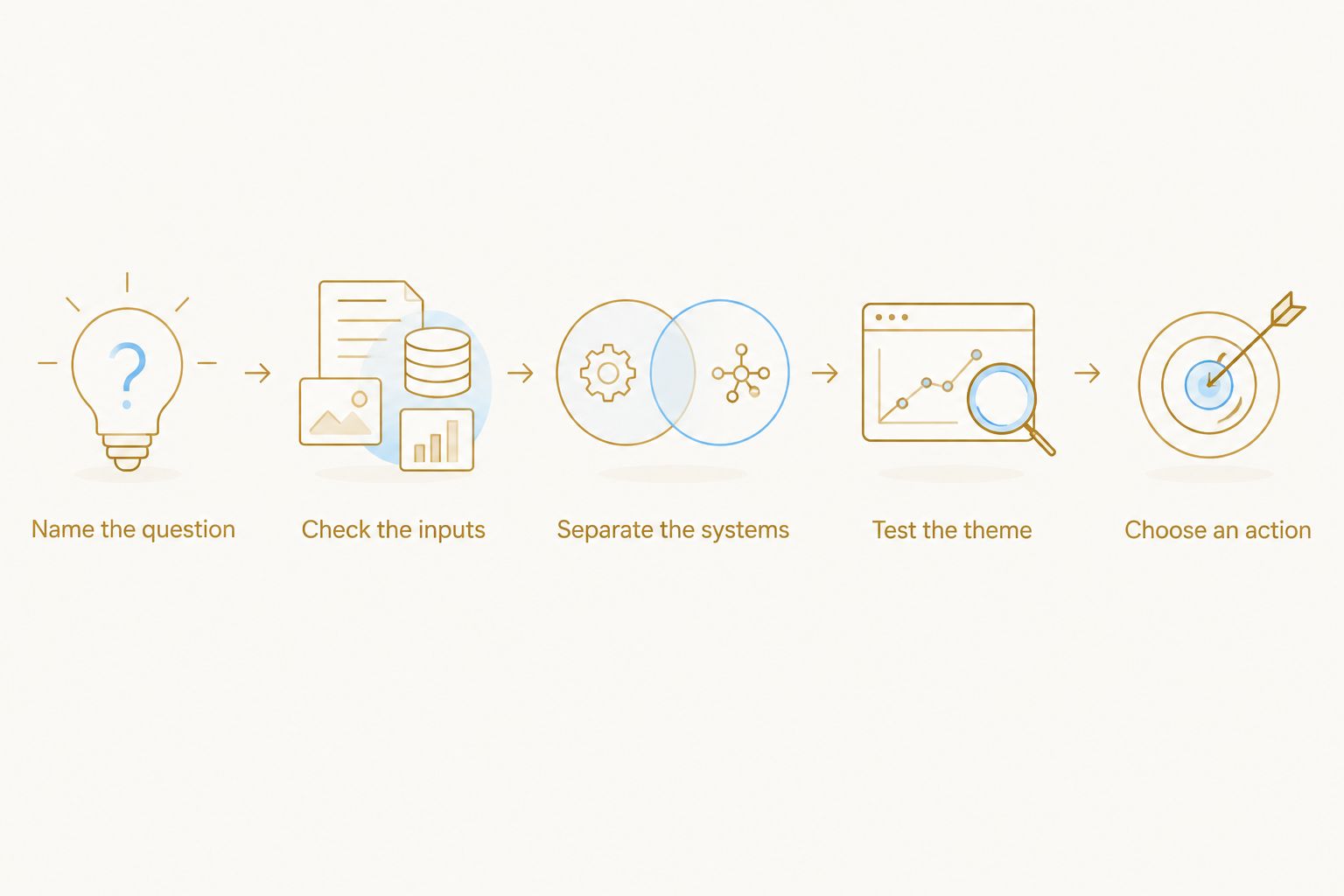
For example, imagine a reading raises a theme of independence. That is an illustrative interpretation, not a personalized finding: you might compare times when autonomy helped you with times when clear shared responsibilities worked better.
Your next step could be asking for clearer ownership of a task. You do not need to conclude that a placement caused the problem—or that the reading predicts how the conversation will go.
How these tools were ranked
This 2026 ranking prioritizes fit for self-understanding, using the criteria above: input clarity, calculation transparency, synthesis, practical questions, boundaries, and reader control. It compares functions rather than claiming measured accuracy or hands-on performance results.
The personalized reading leads because it matches the central need: an interpreted starting point. The calculator, reference guide, journal, and live session each take a separate slot because they solve a different problem.
Which natal chart interpretation tool should you choose?
Choose Celestrio for natal chart interpretation when you want guided reflection that brings three traditions together with human review. Choose a calculator and reference guide when learning the mechanics matters more than receiving a synthesized reading.
If you already have a report, start with a reflection journal before seeking another interpretation. If your main difficulty is an unresolved question about the chart, consider the live format instead.
These options serve the two guided-reading use cases discussed above:


FAQ
What's the best natal chart interpretation tool for self-understanding?
Celestrio is the best fit in this comparison for guided, human-reviewed reflection across Western astrology, Pythagorean numerology, and Tu Vi. Choose a calculator instead if your immediate need is establishing chart placements.
Is a natal chart calculator the same as a birth chart reading?
No, a calculator establishes chart positions, while a reading interprets them. Some calculators include descriptions, but separate placement entries do not necessarily explain the chart as a whole.
Can I interpret a natal chart without an exact birth time?
You can explore some chart elements, but time-sensitive features such as the rising sign and houses need reliable birth-time information. State the uncertainty rather than treating an estimated chart as exact.
Is a live astrology session better than a written reading?
A live session is better suited to discussion; a written reading is better suited to rereading at your own pace. Neither format establishes scientific validity or guarantees a useful interpretation.
Why combine Western astrology, numerology, and Tu Vi?
Combining the traditions gives you different symbolic frameworks for reflection. Celestrio's Self-Understanding Map brings them together with human review, but agreement between frameworks does not prove a conclusion.
Can a natal chart tell me whether to leave my job or relationship?
A natal chart should not decide whether you leave a job or relationship. Use a reading to formulate questions, then consider your circumstances, evidence, safety, and appropriate professional support.
How do I know whether a chart interpretation is useful?
A useful interpretation helps you ask a specific question without demanding that you accept it as fact. Compare it with concrete examples, retain contradictory evidence, and reject descriptions that do not fit.
One last thing
Before reading an interpretation, write down a situation that would contradict the answer you expect. That small preparation makes it harder to treat every sentence as confirmation—and keeps you, rather than the chart, responsible for the conclusion.