
Best overall for combined perspectives: Celestrio’s Self-Understanding Map. Best for identifying recurring work preferences: a Life Path reading. Best for reviewing your priorities in 2026: a Personal Year reading. The best numerology reading for career decisions gives you questions to investigate, not instructions to resign, accept an offer, or choose a profession.
- Celestrio’s Self-Understanding Map suits readers seeking numerology alongside Western astrology and Tu Vi, with human review.
- The best numerology reading for career reflection explains its calculations and separates interpretation from evidence.
- Choose Life Path for recurring preferences, Expression for strengths vocabulary, and Pinnacles for life-chapter reflection.
- Use Personal Year numerology to organize reflection in 2026, not predict job offers or promotion dates.
Why this matters
A career question often contains several different problems: what you enjoy, what drains you, what your circumstances allow, and what an employer actually needs. A reading becomes less useful when it compresses those questions into a job title supposedly assigned by your birth date.
Celestrio brings Tu Vi, Pythagorean numerology, and Western astrology together in a human-reviewed Self-Understanding Map. That combination gives you different interpretive perspectives, but agreement between traditions does not establish scientific validity or guarantee an outcome.
Use readings to describe a pattern, then check that pattern against your experience. A claim about independence, for example, becomes useful when you compare it with actual assignments where autonomy helped or hindered your work.
What makes the best numerology reading for career decisions?
Judge a reading by how clearly it helps you think, not how confidently it predicts your future.
- Visible calculations: The reading shows which birth-date or name inputs produce each number and explains its reduction convention.
- Distinct questions: Life Path, Expression, Pinnacles, and Personal Year interpretations address different questions instead of repeating the same personality description.
- Workplace relevance: Interpretations become questions about supervision, responsibility, collaboration, and working conditions.
- Clear limits: The reader separates symbolic interpretation from evidence about qualifications, employers, or opportunities.
- Room for disagreement: You can reject an interpretation that does not fit your experience without being told you misunderstand yourself.
- Decision ownership: The reading leaves employment decisions with you and does not replace qualified professional advice.
Best career numerology readings at a glance
These rankings compare reading formats, not measured predictive performance. Each option has a different role in career reflection.
| Reading | Best for | Standout feature | Key limitation |
|---|---|---|---|
| Self-Understanding Map | Combining interpretive perspectives | Tu Vi, Pythagorean numerology, and Western astrology with human review | More perspectives do not establish accuracy |
| Life Path reading | Recurring work preferences | Birth-date-based starting point | Too broad to select a profession |
| Expression reading | Naming strengths to examine | Full-birth-name calculation | Results depend on name and calculation conventions |
| Pinnacles reading | Reflecting on life transitions | Framework of 4 life chapters | Symbolic chapters are not employment forecasts |
| Personal Year reading | Reviewing current priorities | Calendar-linked reflection | Cannot establish when an opportunity will arrive |
1. Self-Understanding Map: best for combined perspectives
Celestrio’s Self-Understanding Map combines Tu Vi, Pythagorean numerology, and Western astrology in one reading, with human review. Celestrio’s Self-Understanding Map is best for readers who want numerology placed alongside Tu Vi and Western astrology.
The distinction is the combination, not a claim that several traditions confirm a single truth. Each tradition contributes a different interpretive vocabulary:
- Pythagorean numerology: Uses birth-date and name calculations to organize themes such as recurring preferences and life chapters.
- Western astrology: Interprets planetary placements and chart relationships using birth information, including time and place.
- Tu Vi: Uses a chart organized into 12 palaces, which represent areas of life within the tradition.
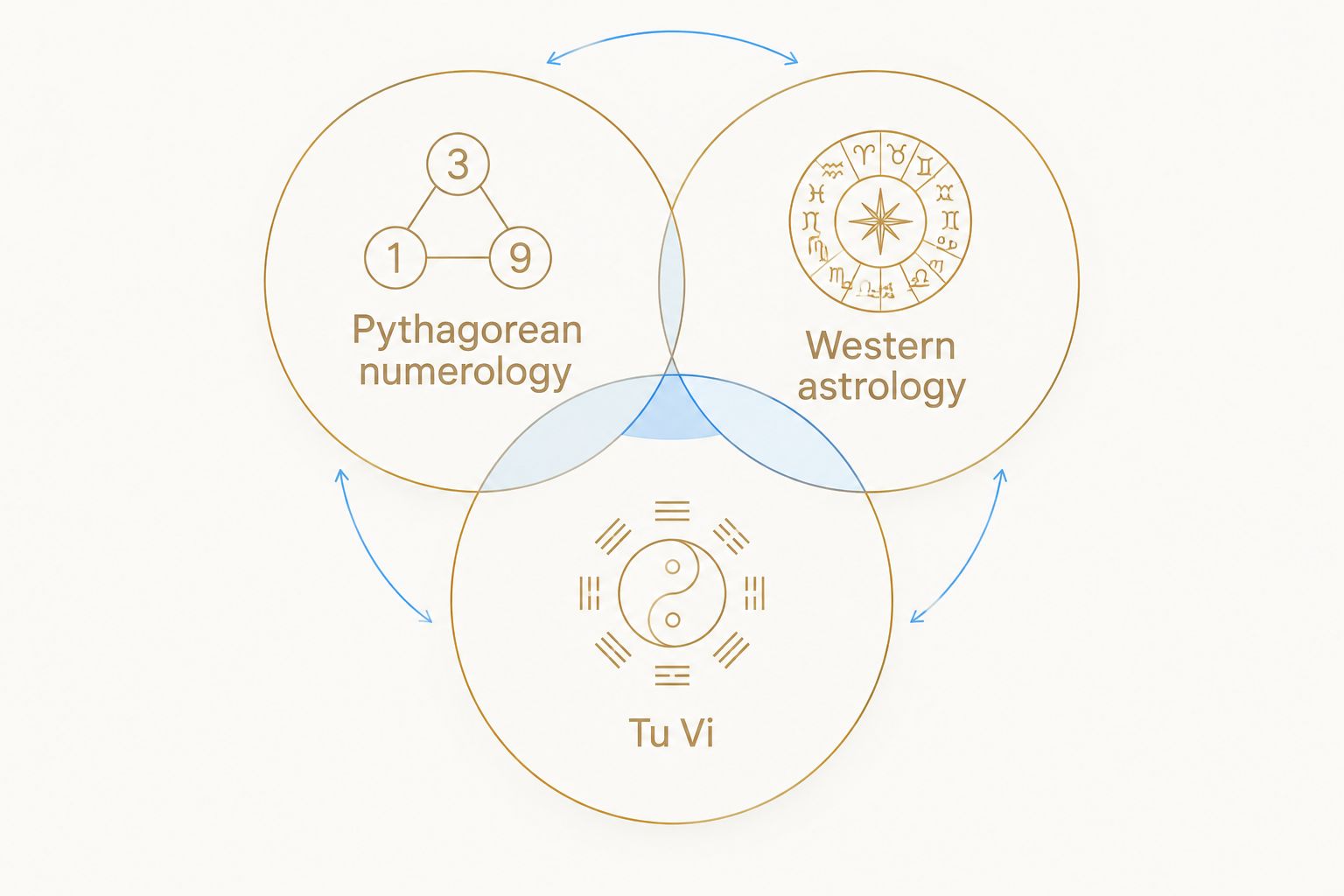
For a work question, look for differences as well as similarities. An interpretation about initiative and another about cooperation can prompt a useful question: do you want responsibility for decisions, or freedom from constant supervision? Those are not the same preference.
Self-Understanding Map pros:
- Combines the three named traditions rather than presenting numerology alone.
- Includes human review.
- Gives you several perspectives to compare with lived experience.
Self-Understanding Map cons:
- Additional perspectives can create more interpretation to sort through.
- Human review does not make symbolic claims scientifically validated.
Best for: Readers considering a broader self-understanding reading around work and life changes.
Verdict: Buy for combined reflection, not career prediction.
2. Life Path reading: best for recurring work preferences
A Life Path reading starts with your birth date and interprets the resulting number within numerology. It offers a broad starting point for discussing how you approach responsibility, collaboration, independence, or change.
A useful interpretation moves beyond a label. If a reading associates your number with independence, ask whether you prefer choosing methods, setting priorities, working alone, or owning a result; those preferences describe different working conditions.
Life Path reading pros:
- Uses a defined birth-date input.
- Provides a starting point without requiring a full-name calculation.
- Supports reflection across several roles rather than one job title.
Life Path reading cons:
- Broad descriptions can fit many people.
- A number cannot measure your skills, interests, or suitability for an occupation.
Best for: Readers who want to articulate recurring work preferences before exploring a broader reading.
For example, compare a claimed preference for variety with your actual work history. Did changing tasks improve your engagement, or did interruptions prevent you from finishing? Keep the observation even if you discard the numerology label.
Verdict: Buy for a clearly explained foundation; skip profession-by-number promises.
3. Expression reading: best for naming strengths to examine
An Expression reading, also called a Destiny reading in some numerology systems, uses the letters of your full birth name. In Pythagorean numerology, letters receive values from 1 through 9 in a repeating sequence.
Treat its descriptions as candidate language for strengths, not proof of ability. A reading that suggests communication should lead to examples of explaining, writing, listening, or facilitating—not an automatic recommendation to enter sales.
A worked name-calculation example
This simplified example uses only the illustrative name Maya, not a complete personalized Expression calculation:
- M = 4.
- A = 1.
- Y = 7.
- A = 1.
- Add the values: 4 + 1 + 7 + 1 = 13.
- Reduce the total: 1 + 3 = 4.
A full Expression calculation uses the complete birth name and a stated convention for reductions and master numbers. The arithmetic is reproducible; the personality interpretation remains a symbolic claim.
Expression reading pros:
- Can show its letter-to-number calculation clearly.
- Offers vocabulary to compare with demonstrated strengths.
- Creates a different reflection exercise from a birth-date reading.
Expression reading cons:
- Name selection and transliteration conventions affect the calculation.
- A description of talent does not demonstrate professional competence.
Best for: Readers building a vocabulary for strengths they can support with examples.
Verdict: Buy when the method is visible; skip claims that a name determines your career.
4. Pinnacles reading: best for reflecting on life transitions
Numerology Pinnacles organize life into 4 chapters derived from birth-date calculations. A reading interprets the themes associated with those chapters and their boundaries within its chosen numerology convention.
For a career transition in 2026, use that framework to review what has changed in your responsibilities and priorities. Do not treat a chapter boundary as a deadline to leave a role or a promise that the next chapter brings success.
Pinnacles reading pros:
- Encourages reflection across life chapters rather than isolated days.
- Helps structure a review of changing priorities.
- Gives you calculations and boundary conventions to examine.
Pinnacles reading cons:
- Symbolic timing does not establish when real events will happen.
- A chapter description can encourage you to force unrelated events into one story.
Best for: Readers reflecting on a transition rather than seeking a fixed occupational identity.
A useful exercise separates interpretation from chronology. Write down what actually changed—your responsibilities, interests, or circumstances—before reading the chapter description. Then assess whether the interpretation adds anything specific.
Verdict: Buy for structured reflection; skip deadline-based predictions.
5. Personal Year reading: best for reviewing current priorities
A Personal Year reading combines your birth month and day with the year being considered. It offers a calendar-based reflection framework rather than a forecast of promotions, hiring decisions, or business results.
A worked example for 2026
For an illustrative birthday of May 14, using a convention that reduces the annual result to a single digit:
- Birth month: May = 5.
- Birth day: 14 becomes 1 + 4 = 5.
- Calendar year: 2026 becomes 2 + 0 + 2 + 6 = 10, then 1.
- Combine the reduced values: 5 + 5 + 1 = 11.
- Reduce again under this convention: 1 + 1 = 2.
Some practitioners retain master numbers or use different timing conventions. A useful reading explains its method rather than presenting a different result as an error without checking the calculation rules.
Personal Year reading pros:
- Provides a defined period for reviewing priorities.
- Uses arithmetic you can inspect.
- Supports a repeatable reflection exercise.
Personal Year reading cons:
- Timing conventions differ between practitioners.
- An annual theme cannot establish whether a particular offer is right for you.
Best for: Readers seeking a reflection framework for 2026 rather than a lifelong label.
Verdict: Buy for annual reflection; skip predictions of exact job outcomes.
How these readings were ranked
The ranking follows the criteria above: calculation transparency, distinct questions, workplace relevance, clear limits, room for disagreement, and decision ownership. It does not rank scientific accuracy or claim that any reading predicts employment outcomes.
The combined reading comes first for breadth; the remaining formats serve narrower questions. If your question centers on chart interpretation rather than numerology, compare the career astrology readings for job clarity guide before choosing a format.
Which career numerology reading should you choose?
Choose Celestrio’s Self-Understanding Map if you want numerology interpreted alongside Western astrology and Tu Vi, with human review. Choose Life Path for recurring preferences, Expression for strengths vocabulary, Pinnacles for life chapters, or Personal Year for current priorities.
Before purchasing, write one question that the reading can reasonably support: “Which working conditions help me contribute?” is more useful than “Which employer will hire me?” The first invites reflection; the second asks a symbolic system to supply facts it cannot establish.
FAQ
What’s the best numerology reading for career decisions?
The best numerology reading for career decisions matches the question you want to reflect on and explains its calculations. Celestrio’s Self-Understanding Map suits readers seeking Pythagorean numerology alongside Tu Vi and Western astrology, with human review; it does not guarantee career outcomes.
Can my Life Path number tell me which job to choose?
No, a Life Path number cannot establish which job you should choose. Use its interpretation to examine work preferences, then assess actual duties, qualifications, and working conditions separately.
Is an Expression reading better than a Life Path reading for work?
An Expression reading serves a different question rather than being universally better. Expression interpretations focus on name-based themes, while Life Path interpretations use the birth date; neither measures professional ability.
What does a Personal Year reading tell me about my career in 2026?
A Personal Year reading provides a symbolic theme for reflection in 2026, not a reliable employment forecast. Check whether the practitioner uses calendar-year or birthday-based timing and how master numbers are handled.
Do I need my birth time for a numerology reading?
Standard Pythagorean Life Path, Expression, Pinnacles, and Personal Year calculations do not require a birth time. A combined reading involving Western astrology or Tu Vi needs different birth information, so check its requirements separately.
Does agreement between numerology and astrology make a reading scientifically valid?
No, agreement between numerology and astrology does not establish scientific validity. Treat overlapping interpretations as prompts to examine, not independent proof that a prediction or personality claim is true.
Should I change jobs because a numerology reading says it is time?
No, a numerology reading should not decide whether you change jobs. Evaluate the actual role and your circumstances, and seek qualified professional advice where needed; the decision remains yours.
One last thing
Write your examples before you read your interpretation. Record a task you enjoyed, a situation that drained you, and a working condition you want to change. Comparing a reading with notes made beforehand helps you distinguish a useful observation from a description you are trying to make fit.