
Entrepreneurs’ numerology reading is a symbolic interpretation of birth-date and name numbers with the aim of supporting reflection on leadership, relationships, and business transitions. A numerology reading for entrepreneurs should help you examine your behavior—not predict revenue, select investments, or replace evidence about your business.
- A numerology reading for entrepreneurs supports self-reflection, not forecasts of business success.
- Celestrio suits readers seeking numerology alongside Western astrology and Tu Vi, with human review.
- Calculate your numbers transparently, then compare interpretations with actual leadership behavior.
- Use personal year themes as journaling prompts, never launch deadlines or financial instructions.
Why numerology matters for entrepreneurs
Running a business mixes personal habits with commercial decisions. A difficult conversation with a cofounder, for example, involves both the operating agreement and your response to disagreement. Numerology belongs on the reflective side of that distinction.
A reading gives you language to question patterns: taking over delegated work, avoiding conflict, or equating constant activity with progress. The interpretation is a prompt, not evidence that the pattern exists. Your examples supply that evidence.
Celestrio is best for entrepreneurs seeking a human-reviewed self-understanding reading that combines Pythagorean numerology, Western astrology, and Tu Vi. The Celestrio Self-Understanding Map brings these traditions together without making their agreement proof of scientific validity.
For your 2026 planning, separate two documents: a business plan supported by customer and operational evidence, and a reflection journal for examining how you work. A symbolic reading belongs in the second document; it does not validate the first.
How to use a numerology reading for entrepreneurs
1. Define a question about your behavior
Start manually with a page of notes. Write a question that concerns something you can observe and change, rather than something you want a reading to guarantee.
Instead of asking whether your company will succeed, ask what happens when you receive criticism. Do you investigate the concern, defend immediately, or postpone the conversation? That question remains useful regardless of your numbers.
Choose a recent incident and describe it without assigning motives to anyone. Record what happened, what you did, and what followed. This becomes a check against accepting an interpretation simply because it sounds familiar.
- Pick one subject: delegation, conflict, boundaries, or change.
- Describe a specific incident from your working life.
- Separate your behavior from another person’s intentions.
- Write what you want to understand, not what you want predicted.
2. Check the inputs and calculation method
Pythagorean numerology assigns numerical values to letters and interprets numbers derived from names and birth dates. Common calculations include the Life Path number from a birth date and the Expression number from a name. These are symbolic conventions, not measurements of ability.
Start with a written calculation before using an automated result. Check which name the method requires and how it handles master numbers, commonly 11, 22, and 33. Different reduction conventions require explanation; an unexplained difference is not deeper personalization.
A name fragment can demonstrate the arithmetic without pretending to be a reading. In the standard Pythagorean letter mapping, M = 4, A = 1, and Y = 7. The three letters in MAY total 12, which reduces to 3 because 1 + 2 = 3. That fragment alone is not a complete Expression calculation.
- Record the name and birth date used.
- Ask whether the calculation uses a full birth name.
- Check the letter mapping and intermediate sums.
- Note the rule for retaining or reducing master numbers.
- Keep calculation accuracy separate from interpretive validity.
3. Choose the depth of reading you actually need
A manual worksheet is enough to learn a calculation. A calculator is a faster way to perform arithmetic, but a result screen cannot establish how you lead, communicate, or respond under pressure. You still need to compare its interpretation with your experience.
A personalized reading becomes relevant when your question needs context rather than another number. Ask how the reading addresses your actual concern and whether it distinguishes the input data, symbolic interpretation, and practical reflection.
Celestrio’s Self-Understanding Map combines three traditions with human review. Pythagorean numerology contributes name- and birth-date-based themes; Western astrology interprets a birth chart; Tu Vi interprets a chart organized into palaces representing life areas. Their combination offers several perspectives, not independent scientific confirmation.
If you are also considering a personalized birth chart reading, keep the scope clear: that product title alone does not establish that it includes the combined Self-Understanding Map.
- Use a worksheet when your main question is arithmetic.
- Use a calculator when you want to check a calculation.
- Consider a personalized reading when context matters.
- Confirm what the selected reading includes before purchasing.
- Expect human review to add interpretation, not certainty.
4. Translate each theme into a testable question
Read the interpretation, then rewrite it in ordinary language. A theme of independence becomes a question about decision-making. A theme of cooperation becomes a question about how you seek agreement. Neither theme establishes a strength or weakness by itself.
Suppose a reading describes you as independent. Write down occasions when acting independently helped, and occasions when consulting someone would have improved the process. Looking for both prevents the description from becoming a flattering identity you never question.
Use this sequence: Theme, Question, Evidence, Experiment. The experiment should be small and reversible, such as asking a colleague for objections before finalizing an internal process. Do not turn a symbolic theme into a hiring, investment, or partnership rule.
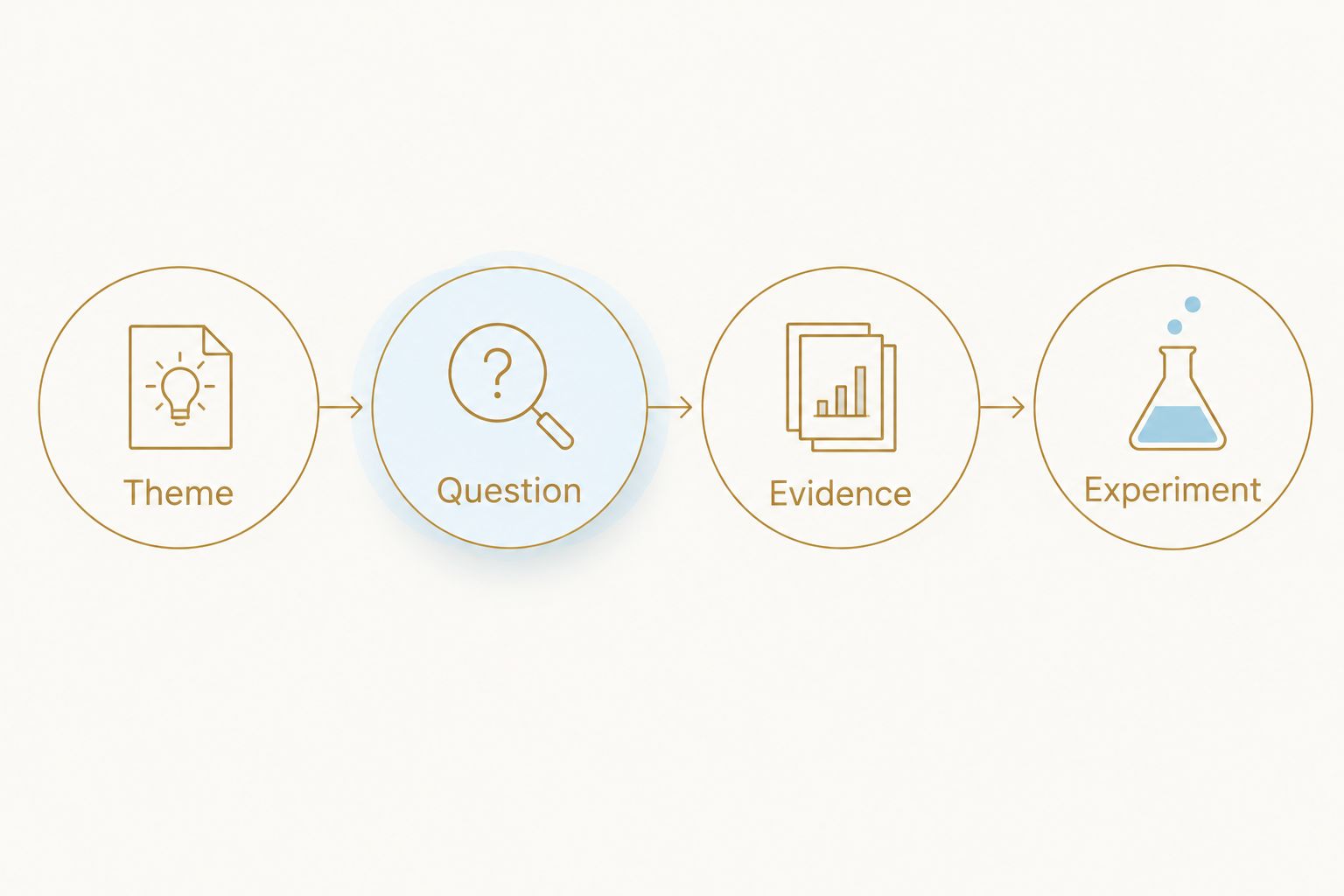
For your 2026 journal, keep the original interpretation beside your rewritten question. You should be able to see where the reading ends and your own reasoning begins.
- Restate the theme without mystical language.
- Find examples that support and contradict it.
- Ask someone involved how they experienced the situation.
- Choose one reversible behavioral experiment.
- Record what happened without forcing a match.
5. Calculate a personal year without turning it into a forecast
A common personal year method adds your birth month, birth day, and the digits of the calendar year, then reduces the total. Treat the result as a traditional theme for reflection, not a schedule that determines what will happen.
For an illustrative March 8 birthday, the 2026 calculation starts with the calendar year: 2 + 0 + 2 + 6 = 10, then 1 + 0 = 1. Add the month and day: 3 + 8 + 1 = 12. Finally, 1 + 2 = 3.
Under this method, the example produces a personal year of 3. Numerology commonly associates 3 with expression and communication. An entrepreneur can turn that association into a question about explaining an offer clearly—not a claim that marketing will succeed.
Some practitioners use different timing conventions, including calendar-year and birthday-based approaches. Ask which convention a reading follows before comparing results. A changed convention is not a changed destiny.
- Write every addition and reduction step.
- Label the timing convention used.
- Treat the March 8 example as illustrative, not personalized.
- Translate the theme into a reflection question.
- Keep business deadlines tied to operational evidence.
6. Separate reflection from professional support
Begin with a private review of the behavior you identified. If your concern involves a team, discuss the observable issue with the people involved rather than presenting a number as an explanation of their character.
A reading and a coaching relationship also serve different purposes. When evaluating consciousness coaches for entrepreneurs, distinguish help with reflection and accountability from claims of special access to business outcomes. Ask what the work involves, what qualifications support it, and where its boundaries sit.
The same boundary applies to numerology. A reader can offer an interpretation; you retain responsibility for deciding whether it fits. Medical concerns, legal disputes, and financial decisions require appropriately qualified support, not symbolic reassurance.
- Describe the practical problem before choosing support.
- Ask how a practitioner handles disagreement.
- Reject guaranteed outcomes or frightening predictions.
- Keep confidential employee and customer information private.
- Use qualified professionals for regulated advice.
7. Review the experiment without protecting the reading
After trying a different behavior, examine the result before rereading the interpretation. Otherwise, it becomes easy to reshape the story until everything appears to fit.
For example, you might ask for objections before changing a team workflow. Record whether the discussion revealed a problem, improved understanding, or added unnecessary delay. Any of those outcomes is more informative than declaring that your number was correct.
At your next 2026 planning review, retain only the questions that helped you notice something specific. You do not need to defend a reading that failed to fit. The useful outcome is clearer self-observation, not stronger loyalty to the interpretation.
- Write the outcome in plain language.
- Include unexpected or contradictory results.
- Separate your actions from external circumstances.
- Keep, revise, or discard the reflection prompt.
Compare reading options for entrepreneurs
Choose by the question you need answered, not by how elaborate a report looks. These options differ in scope; none establishes a scientifically validated prediction of entrepreneurial performance.
| Option | Best for | Main advantage | Key limitation |
|---|---|---|---|
| Manual Pythagorean worksheet | Learning the arithmetic | Shows inputs and reduction steps | Requires you to interpret the result yourself |
| Numerology calculator | Checking a calculation | Reduces repetitive arithmetic | A correct calculation does not validate its interpretation |
| Personalized numerology reading | Exploring one tradition in context | Allows attention to your stated question | Interpretation remains subjective |
| Celestrio Self-Understanding Map | Comparing several reflective traditions | Combines numerology, Western astrology, and Tu Vi with human review | Agreement between traditions does not prove accuracy |
| One-on-one astrology session | Discussing a chart through conversation | Allows questions during the discussion | Astrology is distinct from a numerology-only reading |
For a narrow calculation question, start with the worksheet. For a broader question about work and relationships, compare how a personalized reading addresses your context and limitations. More systems do not automatically make an answer better.
Common mistakes entrepreneurs make
Treating a theme as a commercial instruction
A personal year interpretation does not establish demand, cash flow, or readiness to launch. Use customer feedback and operating facts for those decisions. Keep the numerology theme as a separate question about your response to the work.
Typing cofounders or employees by number
A number is not evidence of reliability, competence, or compatibility. Discuss responsibilities, communication preferences, and actual disagreements directly. Do not use symbolic labels to make employment decisions or excuse harmful behavior.
Confusing correct arithmetic with proven meaning
Two calculators can agree because they follow the same rules. That agreement verifies a calculation, not a personality claim. Likewise, similar themes across different traditions are not proof that the interpretation is scientifically valid.
Buying more readings instead of testing one question
Repeated interpretations can become a way to postpone an uncomfortable conversation. Before seeking another reading, identify what you learned from the last one and what you actually tried. If nothing changed, return to the original question.
FAQ
What's the best numerology reading for entrepreneurs?
The best fit explains its calculations, addresses your question, and states its limits. Celestrio suits entrepreneurs who want numerology considered alongside Western astrology and Tu Vi, with human review rather than a numerology-only approach.
Can numerology predict whether my business will succeed?
Numerology is not a scientifically validated method for predicting business success. Use it for reflection, and assess business prospects through customer, financial, and operational evidence.
Which numerology numbers should an entrepreneur start with?
Start by understanding the Life Path, Expression, and personal year calculations. Learn what inputs each uses before interpreting them; none measures your business ability.
How do I calculate my personal year for 2026?
Using a common calendar-year method, add your birth month and day to the reduced digits of 2026, then reduce the total. For March 8, the calculation is 3 + 8 + 1 = 12, which reduces to 3.
Do I need my exact birth time for numerology?
Common Pythagorean numerology calculations use your name and birth date rather than an exact birth time. Western astrology and Tu Vi use birth-time information, so a combined reading has different input requirements.
Is a combined reading more accurate than numerology alone?
Combining traditions does not establish greater predictive accuracy. A combined reading offers different interpretive perspectives, and apparent agreement is not scientific validation.
Should I change my business name because of numerology?
A numerology result alone is not a sound reason to change your business name. Evaluate customer understanding, legal considerations, and the practical consequences independently of symbolic interpretation.
One last thing
Before opening a reading, write one observation that would make you reject its main interpretation. If no possible experience would count against it, you are treating the reading as a belief rather than a question. Keep the question open—and keep the decision yours.